|
After getting a message from a
senior agent, Mark Lucas, Steed and Emma arrange to meet him at
Norborough railway station. However, when the train arrives there
is no sign of Lucas, so Mrs Peel and Steed board the train. They
don't find the missing agent, but do find his briefcase —
confirming that he was onboard at some point. One of the
passengers, a bridegroom, follows Steed and Emma to Steed's flat
and tries to shoot Steed — but gets shot himself.
A train ticket on the body, to
Chase Halt, leads the pair to an abandoned station close to
Norborough. They find Lucas' body and evidence that he was duped
into thinking that Chase Halt was in fact Norborough station.
Notes from his briefcase lead Steed to think that Lucas was onto a
plot to kill a VIP, and Emma notices that a man named Salt (who
features in some photos of Lucas') was on the train. Salt works
for Admiral Cartney in a Whitehall department which arranges
secure transport for VIPs, so some false information is fed to
Salt to see if he is involved.
Salt does indeed take the bait,
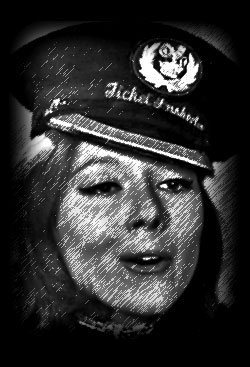
and boards the 8.10pm train for Liverpool. Steed follows to
observe him. However, Steed is recognised and captured — then held
prisoner in the galley carriage, which has been converted into a
mobile headquarters. It transpires that Salt, the train ticket
collector and a couple posing as bride and groom are all cohorts
in a plot to kill the Prime Minister, by use of a bomb on a
particular train carriage. The carriage will be attached to the
PM's train, then the villains will set off the explosion using a
radio signal from their train.
Mrs Peel, with the assistance
of Crewe (a train spotter who lives at Chase Halt), manages to
board the train. She is spotted but defeats her attackers, and
manages to help Steed stop the ticket collector from setting off
the bomb. The plan is foiled and the Avengers are victorious
again, and drive off, by road, in stereotypical British weather! |
|
Many of us fans who have
literally devoured every available Avengers episode and
become so acquainted with the show, its characters and stars, have
remained a bit sceptical about its different follow-ups. A
short-lived stage version and a disappointing motion picture
seemed to reinforce our views, proving that The Avengers
has been rather unwelcoming to formats other than television's.
However, those who have had the chance to dig for hidden
treasures, found the possible exception to the rule. Sonovision's
radio adaptation of The Avengers that aired in South Africa
thirty years ago is a refreshing experience that might well change
our minds and consign our memories of the ill-fated movie to
oblivion. Not only that - this intriguing version of The
Avengers makes a lot of sense, especially the Emma Peel
episodes adapted, because they comply almost entirely with the
original scripts and music score. In other words, this is a bona
fide recreation of the TV show, with no further alterations other
than those essential for a radio adaptation. And that's where the
magic lies: this is pure radio theatre!
Does anyone remember what radio
theatre really was? Sadly, I'm hardly aware of it. Its golden era
took place way back between the 1930s and 60s. However, when TV
transmissions gradually began around the world, radio plays faded
away. I recall catching the last of them towards the mid
Seventies, when I was still a teenager. I never forgot the sense
of adventure that swept me away then while listening to those few
plays. Being so familiar with television, I was surprised that
theatre could also be played on the radio. That was amazing since
the audience had to rely solely on what they could hear. From the
actors' voices to the succession of sound effects - wind blowing,
cars speeding, doors slamming and the like - one had to figure the
whole play out by stimulating one's imagination. You had to work
to see in your mind what you could only in fact hear. Sometimes,
such was the involvement one had in the play, that it was hard to
admit that one was being "taken in" by only a few actors gathered
around a microphone, and someone behind playing hundreds of
different sound tapes or merely making noises withthe most
unexpected devices! That was magic, sheer magic!
Now, three decades later, one
hears a gravely pronounced "The wind was cold and bitter..." as a
blustery breeze engulfs our room leading us to a startling time
tunnel... And the magic springs up again.
True to the script of A
Funny Thing Happened On The Way To The Station (with only
minor changes, except for the tag scene) and supported by a lively
narration, superior performances and an appropriate music score
that at times resembles Johnny Dankworth's zippy jazz tunes,
Train of Events is a delightful piece to enjoy throughout.
The atmosphere of trains and
stations is splendidly generated right from the outset. Even
though we clearly appreciate steam trains "rolling" on radio - as
opposed to the electric trains of the TV version - the Doppler
effect is well handled, creating the feeling of passing trains
quite to perfection. Also the phone calls, Emma listening to
Steed's umbrella and the relatively hard to reproduce on radio
"Diddly-dah, diddly-dum" or the "D-U-R-B-R-I-D-G-E" thingy are
clearly made out without any trouble.
The roles of Crewe and the
Admiral, in particular, drew my attention. The former succeeds in
portraying an old nutcase in very much the same vein as John
Laurie's character of the TV play. The Admiral's part, however, is
developed a bit more into an equally old oddball. For some reason,
he occasionally reminds me of other Avengerish characters -
though not that eccentric - such as Maj.-Gen. Goddard of What
The Butler Saw, Hopkirk of Honey For The Prince or
Jordan (again Ron Moody) of The Bird Who Knew Too Much. To
me, this Admiral sounds much funnier than that of the TV version.
Even the trademark Steed-Emma
banter hasn't vanished on radio. Apart from the lines coming from
the original script, there are some quite enjoyable additions.
Perhaps the best is the first scene together, which incidentally
was never shown on television. Steed is playing with a train set
he acquired for his "retarded" nephew Willy, since the boy needed
"something to concentrate on." However, soon after, the trains
crash suddenly. "You didn't move the points, Steed," Mrs Peel
chuckles, as if suggesting he failed to concentrate enough on the
toy, whereupon Steed concludes he should get "something a little
more simple." No doubt, this could have been a much more amusing
teaser than the one Clemens created for the TV play, though the
"retarded" angle is questionable in this day and age.
I'm bound to say both Diane
Appleby and Donald Monat give strong, fine performances. Neither
sought to emulate their counterparts, Diana Rigg and Patrick
Macnee, and I'm not sure I would have approved that. Both deliver
a free interpretation of our heroes, with different voices,
mannerisms and even British intonations, the latter being somewhat
dissimilar compared with the classic Pat Macnee's or Di Rigg's
"Queen's English" we grew so accustomed to hearing. Mr Monat has
been so very kind to explain to me recently that the plain
modulations they spoke with were in agreement to the standard
followed by many British-born performers working abroad. A "more
internationally neutral tone" was the general trend to "subdue any
'very British' or old-style BBC intonations." Very interesting
remark.
Only the tag scene is
completely different in relation to that we all know from the TV
version. Whether it was deliberate or not is hard to pin down, but
knowing that Sonovision frequently received draft copies of the TV
scripts, such a change might be fully justified. In the radio
version, we have a tag in the style of the Peel monochrome TV
season that in no way detracts from the overall storyline.
If radio is a tricky vehicle
for plays, then a good part of their success relies on talent and
effort. The fact that one gets into a play previously seen on
television a dozen of times, and even so enjoys it as if seeing it
afresh in the mind, is indicative that some kind of magic occurred
during the process. Only talent and effort can achieve that.
Listening to these impeccable Sonovision productions, one becomes
aware of these talents and the dedication of all involved,
concluding that the magnetism of radio theatre still stands, after
so many years. And I'm delighted to revive that wonderful
charisma, arm in arm with The Avengers.
Susana B. Grassino |