|

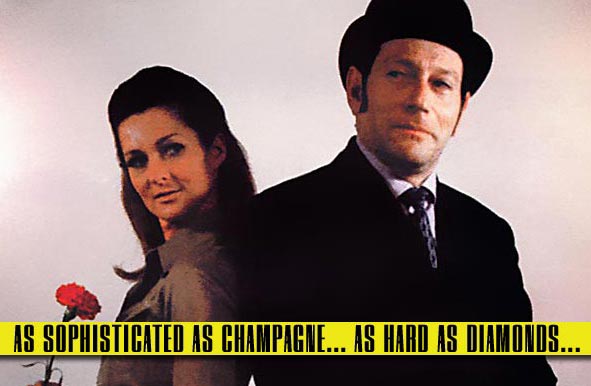
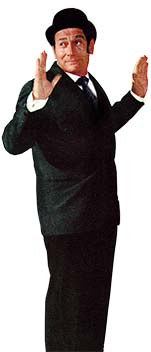
Two years after the original
television series drew to a close, John Steed and Emma Peel
returned to find a new audience in an unexpected locale — South Africa
— and were this time played by expatriate British actors Donald Monat and Diane Appleby.
By arrangement with EMI in the United Kingdom, The Avengers was
adapted from the original television scripts and recorded at
Sonovision Studios in Johannesburg. It was a mainstay of the South
African Broadcasting Corporation's English language service Springbok
Radio's weeknight schedule from 3rd January 1972 until 28th December
1973. Other drama programmes running on the station at the time were
The World of Hammond Innes, Sonovision's Squad Cars (an
absolute pillar of Springbok Radio, running from 1967 to 1985 when the
station closed), and Max Headley — Special Agent, in which
Monat made many appearances.
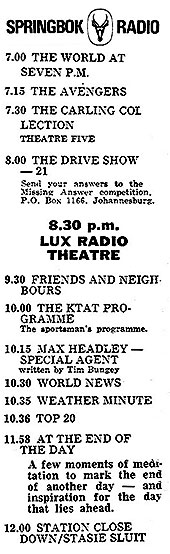 The Avengers would be broadcast
on Monday to Friday evenings in prime-time between 7.15 and 7.30pm on
Springbok Radio on the station's evening frequencies — 4945kHz and
6195kHz. The Avengers would be broadcast
on Monday to Friday evenings in prime-time between 7.15 and 7.30pm on
Springbok Radio on the station's evening frequencies — 4945kHz and
6195kHz.
The very nature of the timeslot
(being only fifteen minutes in length) immediately forced the South
African radio Avengers to stray from the show's traditional
format. On British television, the series had always been presented as
weekly fifty-minute stand-alone dramas, but on radio The Avengers
would serialise the stories over five consecutive weeknights (later
the number of episodes per serial rose to six and sometimes seven
installments).
Serialisation proved not to have as
major an impact on plot structure as might at first have been
envisaged. The original television series had been designed to be sold
to commercial broadcasters around the world, so there were an
abundance of 'cliffhangers' written into each episode - after which,
breaks could be inserted. Many of these dramatic devices were retained
and manifested themselves in climactic episode endings on the radio.
Oddly, despite the fact that the serial format was very much imposed
upon the production, it remains one of the most endearing aspects of
the radio series.
A further stipulation imposed upon
the series was that each episode had to accommodate two 45-second
commercial breaks - one after the opening theme and one before the
closing theme. Allowing for station announcements and the like, this
meant that for each Avengers episode, the producers would have
to produce something in the region of thirteen minutes of programme
material. The commercials transmitted during the
Avengers broadcasts — for beauty products, household
detergents, deodorants and iced lollies — suggest that a family
audience listened to the series, with the South African housewife
being the major target of advertisers at this time of the evening.
In addition to the regular
commercials that aired on Springbok Radio, many timeslots on the
channel were held by sponsor advertisers, who would finance programme
making in return for publicity.
The timeslot that The Avengers
occupied had been sponsored for many years by the detergent manufacturer, Lever Brothers,
and had seen them funding many long-running serials, notably No
Place to Hide, which ran from 1959 to early 1971, though the
serial that directly preceded The Avengers was That Strong
Family, which had starred Diane Wilson as Jody Strong.
It is thought that the concept to bring the series to the airwaves
may well have originated from within the Lever Brothers advertising agency. It was
not uncommon for sponsors to dictate what programmes were to be
produced, based upon what they believed would be beneficial for their
products to be associated with. Quite why the washing powder, Cold
Water Omo and The Avengers were seen as a match made in heaven
is anyone's guess, but this didn't stop each episode being introduced
with the announcement (by Denis Smith and later Malcolm Gooding) "And
now... from the makers of Cold Water Omo..." Omo was Lever Brothers'
major detergent of the day, and the cold water variety was their
latest innovation.
by Alan Hayes
with thanks to Donald Monat, Frans Erasmus and Tony Jay
Back to Top |