|
|
|
Steed has two left feet. Emma dances with danger. |
|
6 x 15-minute episodes
based on the television episode
The Quick-Quick-Slow Death (1966),
written by Robert Banks Stewart
Principal Cast:
Donald Monat as John Steed
Diane Appleby as Emma Peel
Hugh Rouse as The Narrator
Production:
Adapted and directed by Dennis Folbigge
Produced by David Gooden
Transmission on Springbok Radio (7.15-7.30pm):
Episode 1 — Friday 19th May 1972
Episode 2 — Monday 22nd May 1972
Episode 3 — Tuesday 23rd May 1972
Episode 4 — Wednesday 24th May 1972
Episode 5 — Thursday 25th May 1972
Episode 6 —
Friday 26th May 1972
This is a best guess based on available data |
If I Could
Waltz That Way...
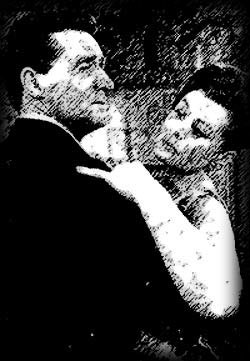
Steed hones his terpsichorean techniques. |
|
PLOTLINE |
|
Willi Fehr, a one-time top
agent and colleague of Steed's, is knocked unconscious in a road
accident whilst in charge of a pram — a pram which contains the
body of a dead man in full evening dress. Fehr seems unwilling or
unable to say what has happened, so the only lead is a tattoo on
the dead man's arm. Mrs Peel discovers that the tattoo identifies
the body as one Arthur Peever, and this is confirmed when Steed
checks on the hired suit the dead man was wearing. It becomes
clear that the two agents are on the right track when both the
assistant at the suit hire shop, and the tattooist are both
murdered. However, the tattoo artist leaves a clue to his killer —
the assassin has a rose tattoo on his wrist.
Another clue turns out to be
the corpse's shoes — pumps supplied for students at a dancing
school, Terpsichorean Training Techniques (which also explains the
evening suit). Mrs Peel joins the school as an instructress,
where she discovers that one of the pupils is 'Arthur Peever', who
seems alive and well — although he does not resemble the corpse
Fehr was ferrying at all. The dance school is run by Lucille Banks
with a chief instructor by the name of Ivor Bracewell, and the
drunken school band leader — Chester Read. Steed also helps out
with the investigation by enrolling as a student at the school. He
notices how Miss Banks becomes interested at his interview, when
he mentions that he has been out of the country for some time, and
has no close friends or relatives.
Knowing that 'Peever' is an
imposter, Mrs Peel goes to see Bernard, a craftsman at the shoe
shop in the hope that he might have information about the dance
students — Bernard has been supplying cut-price dancing shoes to
the TTT pupils. However, Bernard has been suffocated by being
knocked unconscious and having his face pressed into a bowl of
drying plaster. So Mrs Peel returns to the school to snoop on
Lucille and company. She sees Lucille dancing with a dummy, which
is then swapped for a man when Lucille passes out of sight in the
ballroom. Emma reports what she's seen to Steed, when they meet at
the dance Gala. They realise that this is the method by which
people disappear and are replaced with incoming foreign agents who
take on the missing person's identity. They know that the next
victim will be wearing number 9 on his back at the Gala, and when
Steed is given the number 6, they think he is not the victim. But
Lucille cunningly upturns his number to read '9' and Mrs Peel
realises Steed is in danger. Steed and Lucille dance away, Mrs
Peel and her partner follow. She manages to warn Steed and
together they overpower their partners — Lucille and Bracewell.
Peever also attacks but is knocked out. However, Chester Read
comes after them with a gun and reveals himself as the ringleader
of the operation — but he too is despatched. Steed and Mrs Peel
dance off into the night. |
|
REVIEW |
|
Despite the scene being set in
everyday England, it's not long before we are introduced to
something out of the ordinary — the early morning pram-walker. The
stars of the show get the intonations just right whereas the
interrogator doesn't sound quite believable. The scene at the
tattooist leads the listener to think all about tattooing for a
while, at the expense of concentrating on the plot, until they are
brought back abruptly by some impending skulduggery. The serial
continues uncharacteristically without a noticeable recap which is
a little confusing when returning to the story. The man in the
shoe shop, coming across as older than the one on TV, is good
role-playing as he is supposed to be expert and age brings
experience. There is no recap again as Mrs Peel moves between
episodes from the shoe shop to the dancing school. Maybe the
length of the plot didn't allow for the luxury of recaps this
time, but their inclusion would have made things clearer.
Initially, there was not that much difference between the voices
of Lucille Banks and Mrs Peel to me, but gradually it became
easier to distinguish them from one another. The introduction of
another character, Mr. Peever, by Miss Banks brings all the loose
plot strands together and we get an inkling that we are dealing
with identity fraud. Some of the other characters that are
introduced along the way come over convincingly, such as Peever's
bank manager; a good part. I enjoyed the narration at both the
dance studio and then returning to the tattooist's. Donald Monat
portrays a very laid back "Jonathan Steed" whilst attempting to
fit into the dancing school without making himself any more
noticeable than any of the other new pupils. Patrick Macnee is
more amusing in the TV version but I think this is an excellent
'undercover detective' approach here.
Mrs Peel is not left behind for
coolness in getting rid of the tattooed gift from Steed without
taking his advice ("Eat it!"). As they are whispering, she comes
across as every bit his equal, I feel. The slightly lower level
with a certain intonation makes them also appear to be right
beside you. Nikki seems a more noticeable character in this radio
version, appearing quite a few times (as on TV), and she comes
over in a particularly naturalistic fashion, I thought. I didn't
get the "You're too good for the chorus" quip about Steed by the
narrator but no doubt there's an explanation!
The music builds up in the
final episode. Those speaking with a tiny echo in their voice
sound like they are at the back of the ballroom; it's a nice vocal
effect to employ. This is better than just hearing the person in
the distance more quietly which could be confused with someone
whispering I suppose. It also allowed Steed and Mrs Peel to
whisper earlier creating the 'near' sound. They seem great
methods. This one goes along quite well and what comes across most
is how capable this Mrs Peel can be.
Ron Geddes |
|
DIFFERENCES COMPARED
TO THE TELEVISION EPISODE |
|
Name Changes:
Character Changes:
Storyline Changes:
-
The
scene with Willi Fehr and the pram is said, in the radio version,
to take place in the early morning in Shoreham, a town south of
London. No attempt is made in the television episode to locate the
action.
-
Two charladies, Daisy and
Elsie, appear at the beginning of the first radio episode. They
act as a narrative device, commenting on how strange it is to see
a man, Willi Fehr, pushing a pram along the street, and they react
to his subsequent accident. In both versions, the sight of a man
pushing a pram is treated as being unusual — several decades
later, marital roles have changed to such an extent that this is,
today, nothing unusual at all!
-
When Steed is interviewed by
Lucille prior to joining the school, he mentions that he did once
have a girlfriend but that she was run over by a bus in London. In
the TV episode he claims that the unfortunate woman was eaten by
crocodiles whilst on an Amazonian trek.
-
An omission from the radio
programme (probably due to it being a visual joke) is that no
comment is made about Chester Read's band — the TV version shows
the 'band' to be a group of life size cut-outs of Chester playing
various musical instruments, together with an open-reel tape
recorder actually providing the music.
-
Lastly, the TV episode shows
Chester threatening Mrs Peel with a blade concealed in his
conductor's baton — the radio show changes this to a gun.
|
|
PRODUCTION NOTES |
|
Alys Hayes |
Back to Top |
|
|
|