|
|
|
Steed is shot full of holes. Emma sees stars! |
|
6 x 15-minute episodes
based on the television episode
From Venus With Love (1967),
written by Philip Levene
Principal Cast:
Donald Monat as John Steed
Diane Appleby as Emma Peel
Hugh Rouse as The Narrator
Production:
Adapted and directed by Dennis Folbigge
Produced by David Gooden
Transmission on Springbok Radio (7.15-7.30pm):
Episode 1 — Thursday 28th September 1972
Episode 2 — Friday 29th September 1972
Episode 3 — Monday 2nd October 1972
Episode 4 — Tuesday 3rd October 1972
Episode 5 — Wednesday 4th October 1972
Episode 6 —
Thursday 5th October 1972
This is a best guess from available data |
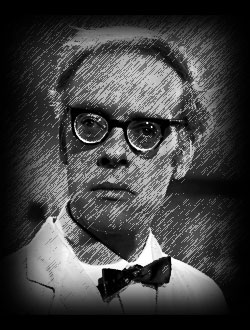
Optical
Problems?
Dr Primble offers laser treatment
of the lethal variety. |
|
PLOTLINE |
|
Members of the British Venusian
Society, an organisation set up to observe the planet Venus, are
literally and fatally turning white while on watch at night! A
phone call from Mother sends Steed and Mrs Peel off to investigate
this phenomenon. Mrs Peel makes contact with Bert Smith, an
upper-class chimney sweep and member of the society, but before he
can give her much information, he is killed by a blinding white
flash. Meanwhile, Steed joins the BVS (whose secretary is the
aptly named Venus Brown), and is sent for an eye test with the
society's optician, Dr Primble. Mrs Peel tracks down another
member, Lord Mansford, but he too is killed before she can
interview him.
Steed, now a member of the BVS,
goes to see Brigadier Whitehead (another member), shortly after
Venus Brown has paid the old soldier a visit. However, once again
he gets there too late — only managing to hear the strange
whooshing sound as it precedes a blinding flash. Fortunately, the
Brigadier was in the middle of taping his war memoirs and since
the recorder was left running it has captured the sound of the
lethal ray, providing Steed with another clue. Mrs Peel,
pretending to be a journalist, visits the BVS and plays the tape
to Venus and Crawford (the society's radio astronomer) hoping that
they'll incriminate themselves in the deaths of the other members.
However, it becomes apparent that they are not involved, and Venus
herself only narrowly escapes being zapped by the "Venusian" ray
whilst Mrs Peel is there.
Steed, on planet watching duty
at the observatory, only avoids being killed by the ray by using a
tailor's dummy to sit in the viewing position by the telescope. Dr
Primble arrives soon after the attack and is convinced that it is
all part of a Venusian invasion. After another attack, one of
Steed's colleagues identifies the effects of the ray as coming
from a laser, and that one of its uses is in eye surgery. Mrs Peel
gets to Primble's opthalmic practice, but is captured by Primble
and his assistant. It seems that he is behind the deaths, using a
sports car with a laser gun attached, and is killing off members
of the BVS in retaliation for having funds diverted from his
medical research and redirected to the society. Steed arrives just
in time to stop Mrs Peel being bleached, and destroys Primble's
laser — knocking Primble out in the process. |
|
REVIEW |
|
The radio play is the form of
performance closest to literature itself. Like literature, the
success of a radio drama depends entirely upon the effect of words
upon its audience. Unlike the Globe Theatre, it is a cockpit that
can easily hold the vasty fields of France, since there is no
dissonance between the eye and the imagination. True, the writer's
words are abetted by a variety of sounds, not the least of which
is the timbre and expressiveness of the actors' voices, but all
sounds are merely an echo to the sense in a drama, even in opera.
As a writer, I've always been
fond of radio plays. You don't have to worry about the director
cutting your dialogue so he can insert a logically stupid but
viscerally stunning visual effect in its place (has anyone else
noticed how truly awful the writing is in most special effects
movies?) If anything, for a radio play, even more words are
needed. Since I usually get paid by the word (except for labours
of love, of course, like this review), I'm all in favour of that.
 One thing is certain: the FX in
your head cost the producers considerably less than they do in a
visual medium. For this reason, radio drama is a particularly
effective solution to dramatising fantasy and science fiction.
Long before The Lord of the Rings was produced successfully
on celluloid, it had been well presented on radio. So what could
be more natural than adapting the Brian Clemens-era Avengers
episodes? In a sense, of course, it's problematic, because
everybody already knows what the episodes are supposed to look
like. On the other hand, I can't claim I see Patrick Macnee when I
listen to Donald Monat, although Steed's bowler and brolly are
still in evidence. Which brings me (at last) to From Venus With
Love. As science fiction, the story is a complete disaster.
Real lasers are silent. Real lasers do not dramatically increase
ambient heat. Real lasers do not cover everything in their
vicinity with white ash. Real lasers do not require the use of a
parabolic dish antenna (as in the TV version). Despite all that,
From Venus With Love has long been one of my favourite
Avengers episodes because of all of the typical Avengerian
quirks in the plot. One thing is certain: the FX in
your head cost the producers considerably less than they do in a
visual medium. For this reason, radio drama is a particularly
effective solution to dramatising fantasy and science fiction.
Long before The Lord of the Rings was produced successfully
on celluloid, it had been well presented on radio. So what could
be more natural than adapting the Brian Clemens-era Avengers
episodes? In a sense, of course, it's problematic, because
everybody already knows what the episodes are supposed to look
like. On the other hand, I can't claim I see Patrick Macnee when I
listen to Donald Monat, although Steed's bowler and brolly are
still in evidence. Which brings me (at last) to From Venus With
Love. As science fiction, the story is a complete disaster.
Real lasers are silent. Real lasers do not dramatically increase
ambient heat. Real lasers do not cover everything in their
vicinity with white ash. Real lasers do not require the use of a
parabolic dish antenna (as in the TV version). Despite all that,
From Venus With Love has long been one of my favourite
Avengers episodes because of all of the typical Avengerian
quirks in the plot.
How can you not love Bertram
Fortescue Winthrop-Smythe, the blue-blooded chimney sweep? (Note:
Bert in the radio version is considerably less Bertie Wooster-like
than in the TV version, but still an upstanding exemplar of the
eccentric gentry.) How can you not adore Brigadier Whitehead
fearlessly galloping between gramophones in performing his own
radio play adaptation of his memoirs? How can you fail to be
delighted with Primble's eye chart, portraying, as it does, images
of different hats in place of the far more prosaic alphabet (or
those boring 'E's pointed in different cardinal directions from my
long ago youth)? And of course, there is the arch humour of the
title itself, a gentle nudge in James Bond's ribs.
One wishes to report that in
this episode, in which the sonic has an importance far beyond that
in any other Avengers episode, the radio play has
triumphed. One wishes to report that comparison with the TV
original is superfluous. Alas, one cannot honestly report these
things. The radio version is not without its disappointments.
Venus Brown was an attractive (if somewhat distracted) wide-eyed
and youngish brunette in the TV version. On the radio, she is a
twenty-something blonde bombshell, whose exaggerated come-hither
vocalisations sound like they are being uttered by a
forty-something torch singer. The slapstick climax of the TV
version, which was filled with visual gags, could not be adapted
successfully for the radio, making for a too-abrupt denouement.
But what of the all-important
sound effects? Such effects are produced in radically different
ways in the two media. Filmed television adds sound effects in
post production, i.e., after the film is 'in the can', as we say
in Hollyweird. This is done by 'Foley men' (presumably named after
the originator of the technique). When you see a cinematic burglar
step on broken glass and hear the crunch of his boot further
fracturing the fallen fragments, the odds are overwhelming that it
was added by a Foley man long after the actors had moved on to
their next projects. Radio plays, on the other hand, stick much
closer to their live broadcast roots. Sound effects are performed
by various means, frequently by the actors themselves, as the
scripts are being read into the microphones.
In the case of From Venus
With Love, the critical sound effect is that of the
high-powered laser. On TV, this effect was produced by combining
several sounds, including a recording of a bullet ricochet being
played backwards and an electrical discharge against a charged
plate. In the radio version, the sound was obviously mostly
electronically generated - coming off like some gizmo on the
bridge of the Sixties-vintage incarnation of the Starship
Enterprise. It has far less impact.
But all is not lost. There is a
charming new scene at the beginning, where Emma and Steed are
dining in a rooftop garden, and Appleby's and Monat's performances
throughout are completely engaging. The droll humour of the
narrator is on a par with other episodes. And the tag sequence
suggests an amusing alternative to Cold Water Omo.
James Lincoln Warren |
|
DIFFERENCES COMPARED
TO THE TELEVISION EPISODE |
|
Name Changes:
Character Changes:
-
Mother is mentioned in this, as in some other radio adaptations of
the Mrs Peel adventures, but does not actually appear. In this
serial, Steed receives a telephone call in the rooftop garden,
ordering him to investigate Cosgrove's death, but we do not
actually hear Mother's voice.
-
Dr Primble comes across as
being a much older man in the radio version.
Storyline Changes:
Bloopers:
In Episode
Four, narrator Hugh Rouse at one point refers to Dr Primble as
"Primple".
In Episode Five, Venus holds
"the earpiece of the phone next to the speaker" (of a tape
recorder). As any self-respecting old-time radio enthusiast will
tell you, you should hold the microphone (or in this case, the
mouthpiece) to the speaker...
Brigadier Whitehead is referred
to as Major Whitehead in Episode 2, but reverts to his correct
rank when his character appears in Episode 4.
|
|
PRODUCTION NOTES |
-
There are interesting
pronunciations of 'laser' in this serial. All the characters bar
Dr.Primble talk of 'lacers'. Primble, of course, should know his
stuff, and clearly does!
-
This serial is known to have
been the next one broadcast after Stop Me If You've Heard This.
Alys Hayes |
Back to Top |
|
|
|