|
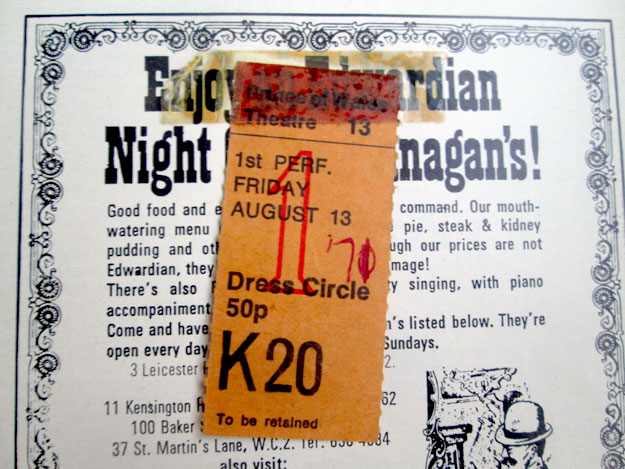
Photograph by Graham Briddon, used
with permission
The 1971 theatre production of
The Avengers was an unusual and unwieldy beast. Hugely ambitious
and technically challenging, it
was hailed in pre-publicity by John Mather, the show's producer, as the show
which would "blast
the British theatre into the Seventies". Sadly, this proved to be an unfortunate
boast, as the production was notoriously beset with technical problems
and met with a series of scathing reviews in the national and theatre
press. Both these factors contributed to a hasty curtailment of the
London West End run, and that was very definitely that.
A scant few months earlier, the situation
had looked decidedly more rosy for The Avengers. News of the imminent production had ignited considerable
interest from the British media right from the day it was announced in
April 1971. Several national newspapers carried brief interviews with
John Mather, in which he claimed that the groundwork was done and that a script
(by Avengers scribes Terence Feely and Brian Clemens) was in
place, but that he now faced "the difficult task of finding the stage equivalents of the Patrick
Macnees, the Honor Blackmans and the Diana Riggs of this world". He
had in fact approached Macnee to reprise his role of John Steed in
this stage adaptation, but the popular
Avengers star — an experienced stage performer — had declined the offer as he strongly felt that The Avengers
was not suited to any dramatic media other than television. "The stage
is a place that should look dazzling and beautiful, but basically
remain a place for the exchange of ideas, dialogue and characters —
and not whiz-bang-wallop," said Macnee when interviewed in the late
Eighties for Dave Rogers' The Complete Avengers book.
John Mather was not disheartened by
Patrick Macnee's decision and announced in May 1971 that actor Simon
Oates was to be the man to play John Steed under the proscenium arch.
Oates was well-known to the British public for his role in the hugely
popular and hard-hitting BBC television drama series, Doomwatch,
in which he played Dr John Ridge, part of a government department
investigating environmental issues. Ridge was an intelligent and
dapper ladies man and Oates' assured performance in the role
undoubtedly brought him to Mather's attention as a possibility for
Steed, particularly as the character had been redefined for the stage
as something of a tiger with the fairer sex. His partner, Hannah
Wilde, is apparently the only woman who has the willpower to hold out
on his advances! Oates had also previously
appeared in The Avengers opposite Patrick Macnee on two
occasions, in You Have Just Been Murdered (1967) and Super
Secret Cypher Snatch (1968). When approached to play the role,
Simon Oates was at first wary. "I made a point of ringing Patrick
Macnee, not least because Pat is a great friend of mine. I was
thinking that there might have been something devious going on. Were
they trying to blackmail Pat into accepting the role, using me against
him? Were they saying to him that if he wouldn't do it, we can easily
get someone to take the role off you — we don't really need you. I was
concerned because, after all, it was his show." Macnee was grateful
for the call and told Oates to accept the role with his blessing. Dave Rogers, the author of several
authoritative books on The Avengers, was one of the fans of the
series lucky enough to have seen the play staged at The Birmingham Theatre. In his accounts of the stage play, Rogers remarked that
"Simon Oates, immaculate in his trendy suits, shooting jackets and
Cuban heel shoes, made an excellent Steed". Six years after the stage
play, Oates could be seen for one last time in 'Avengerland', playing
the part of Spelman in Hostage (1977), a second series episode
of The New Avengers.
Joining Simon Oates on stage would
be a principal cast most of whom had previously taken part in The
Avengers on television. Sue Lloyd, the glamorous co-star of the
ITC espionage series, The Baron, had appeared in A Surfeit
of H2O (1965) and was making her London stage debut when she
portrayed Steed's sidekick, Hannah Wild (a character name recycled
from The Superlative Seven (1967), also written by Brian
Clemens); arch-villain Madam Gerda was to be played by sultry femme
fatale, Kate O'Mara, who had previously graced the episode Stay
Tuned (1969) with her presence and the talented comedy actor and
writer, Jeremy Lloyd, veteran of two Avengers episodes —
From Venus With Love (1967) and Thingumajig (1969) — was
booked to play Carruthers. Anthony Sharp, playing Walters, the
government Minister for Internal Security, was the exception to the
rule, in that his appearance in the series was at this point yet to
come. He would go on to feature in To Catch A Rat (1976), a
superb first series episode of The New Avengers.
An interesting aside concerning Sue
Lloyd's role is that Hannah Wilde may possibly have marked the
Avengers debut of an actress later made famous by the series —
Joanna Lumley. Lumley auditioned for the role but was not successful
in the venture. When interviewed by Dave Rogers for Look Who's
Talking, an interview special Avengers fanzine, she
recalled that, "I was turned down because I was an unknown at the time
and, because the male lead they'd chosen also wasn't very well known,
they decided to go for someone more famous and in fact, they chose Sue
Lloyd". Lumley's own date with The Avengers came along five
years later — and today she is one of the UK's best loved
personalities.
The somewhat onerous task of
realising Mather's bold and ambitious ideas for The Avengers
fell to the experienced and much-loved comedy actor Leslie Phillips.
Phillips is best known for his roles in the early Carry On...
and Doctor film series, where he regularly played the likeable,
suave romantic lead. In recent years, Phillips has marked himself out
as one of Great Britain's most talented and well-respected veteran
actors. He was made a Commander of the British Empire (CBE) in the 2008 New
Year's Honours, to mark an incredible seventy-five years in
showbusiness.
In transferring The Avengers
to the stage, while Mather, Feely and Clemens wished to preserve the
adventurousness of the series, they opted for a much lighter touch
than was witnessed even in the later episodes. 'Comic', 'kinky' and
'sexy' were clearly the buzzwords employed when writing the script,
hence O'Mara's Madam Gerda came to be kitted out in thigh-length
boots and a shiny black PVC suit (which unfortunately creaked terribly
with every movement the actress made and made it exceptionally
difficult for her to sit down), a cast of thirty young and
attractive female extras in figure-hugging outfits were to be seen on
stage, and John Steed was given a succession of clever lines and
quips, some of them rather risque.
The plot itself was somewhat
simplistic compared to the average Avengers episode, leaning
more towards the pantomime form than that of straight drama. Madam Gerda was a typical pantomime
villain, painted in the broadest of broad strokes, the leader of the cheesily
monickered 'Forces of Evil' and out to overthrow the governments of
the world for no adequately explored reason. Moreover, she plans to
infiltrate international spy networks using the McGuffin of
invisibility, made possible by the ultimate Fifties B-movie cliché,
the Giant Computer Brain — or George for short. Peter Cook's E.L.Wisty would have been proud
— a stage teeming with thousands of invisible nudists. For some
reason, again not adequately explained, Steed is the only person who
can see the invisible dolly-birds, and ultimately defeats Gerda and
her henchwomen, but not before he's been subjected to a court-martial
and is stripped of his rank and licence.
Co-writer Terence Feely later
claimed that the stage play had allowed he and Brian Clemens to let
their imaginations run free. "We had a wild story, far wilder than
anything that appeared on television," he recalled in the late
Eighties, "because we said that if we were going to do it for the
theatre we had to be further out than anything the audience had seen
on television — otherwise, why should they come to the theatre?"
As has been mentioned, the show was
technically very demanding. Sixteen separate high-tech sets were built
for the show, ranging from a helicopter cockpit with a dangling rope
ladder (from which Kate O'Mara fell painfully in one performance) to
government offices and Steed's Bentley to the Brain Room of the Master
Computer, most of them complete with tricky props and operational
functions. Not unlike the television series, back projection of
pre-filmed backgrounds was also employed for a number of scenes. In
her 1998 autobiography, It Seemed Like A Good Idea At The Time,
actress Sue Lloyd revealed that the show's technical requirements far
exceeded the norm at a provincial theatre like The Birmingham Theatre
in the West Midlands, where the production received its premier run.
"The sets were so complicated that on the first night, we had to
borrow all the stagehands from Birmingham's other theatre, the
Alexandra, to help out."
The show opened at The Birmingham
Theatre on Thursday 15th
July 1971, playing there for ten days, with its final performance on
the night of Saturday 24th July 1971. The cast and crew then travelled
down to The Prince of Wales Theatre on Coventry Street in London's
West End, where set-up work and further rehearsals commenced. A mere
nine days after the final Midlands performance, The Avengers
premiered in the West End.
Contemporary accounts of the brief
run at the Birmingham Theatre are not particularly forthcoming today
(with the exception of Dave Rogers' recollections in his books),
but it rapidly becomes clear when reading reviews of the West End run
that this proved a very troubled production. The level of technical
ambition behind The Avengers clearly exceeded the limits of
what was ultimately practical within the constraints of its budget and
the short rehearsal period before the public performances.
Interviewed in August 1987 for the BBC2 programme, On Stage,
Sue Lloyd commented that "Kate O'Mara was supposed to be invisible at
certain times and special effects allowed her to vanish into special
props which would part to let her inside. There was this trick sofa,
which had been designed to swallow up. Unfortunately, what happened
one night, was that she pressed the button and nothing happened. After
several uneasy moments, she gave up trying and tiptoed off the stage.
In the next scene, Jeremy Lloyd came on and was supposed to be sitting
down for a straightforward tea scene. He no sooner sat down when,
wham, the sofa opened up like giant jaws and poor Jeremy disappeared
into it." Sue Lloyd went on to recall that the cast and audience were
in fits of laughter at this, not least because her co-star's head and
shoulders remained stuck out at an odd angle from the malfunctioning
sofa, his outstretched hands, still clutching the cup of tea,
flailing helplessly in mid-air. "Normally, I'm good at ad-libbing,"
Lloyd said later in her autobiography, "but the killer sofa was too
much for me. I couldn't go on. I stood there, rooted to the spot,
shaking with laughter. All I could think was that Jeremy looked
exactly like Archie Andrews, the ventriloquist's dummy. I tried to
pull him out, but it was no use. The sofa wasn't giving up its victim
lightly. In the end, they had to bring the curtain down and send in a
couple of strong stagehands to release him."
Another memorable mishap, also
related by Sue Lloyd, this time in her autobiography, again concerned
Kate O'Mara. "In one scene, the set included a number of decorative
columns which appeared solid, but which were in fact elasticated. Kate
had only to lean against the column, part the hidden seams, slip
inside and the seams snapped shut behind her, completely concealing
her inside. On this particular night, as she disappeared into the
column, the elastic snapped shut, biting off Kate's hairpiece in the
process. The evil Kate had gone, leaving behind her, dangling in
mid-air, what appeared to be an outsize tarantula spider. The
tarantula stubbornly refused to move, and remained dangling throughout
the scene, bristling alarmingly at the other actors, who had to
pretend to be extremely short-sighted every time they passed it." By all accounts, these kinds of mishaps
could hardly be described as isolated
incidents.
Writing in Plays and Players in September 1971,
reviewer Michael Coveney noted that he saw actors "bump(ing) into
furniture in the black-outs, only to be seen still bumping into
furniture when the lights came up. It was only out of a masochistic
sense of duty that I stayed to the end". Sadly, Coveney's comments were
fairly typical of the reviews the play received. In the same piece, he
uncharitably compared Simon Oates' movement on stage to that of "a
flowerpot man on hot coals" and, quite justifiably, questioned why
John Steed now "drinks wine of doubtful vintage straight from the
bottle and drives a Bentley that looks like a disused dodgem car".
Meanwhile, Arthur Thurkell, in an August 3rd 1971 review for the
Daily Mirror national newspaper, slated the production as "a sorry
disappointment" that offered nothing much besides "consistent drivel".
He singled out the "amusing performance" of Anthony Sharp as the
Minister for Security as one of the few compensations, before noting
that he had a sneaking suspicion that Madam Gerda's brainwashing
computer had "nobbled the authors of this strange mish-mash in which
the machines are more interesting than the characters".
One of those "nobbled" authors,
Terence Feely, put his side of the story when interviewed by David
Richardson for TV Zone magazine in 1993: "It didn't work because the
producer said he could do the effects, and Brian and I suspected he
couldn't." Mather had apparently talked them around to his way of
thinking, saying that he would employ Edwardian era stage illusions
and employ a real magician to co-ordinate them. "We trusted the guy
and it didn't work." Even the Bentley they had been encouraged to
include in the script for Steed to drive didn't come anywhere near
expectations. "It was a cardboard cut-out that was pushed on by two
stagehands who just stopped before you see them. It was a mess..."
And so the die was cast. Unable to
weather the storm caused by the reviews and entice the paying public
into the auditorium each night, The Avengers limped to its
inevitable early closure at the Prince of Wales Theatre just three
weeks after its London premiere. A sad end to an ambitious endeavour.
Alan Hayes
Back to Top |