|

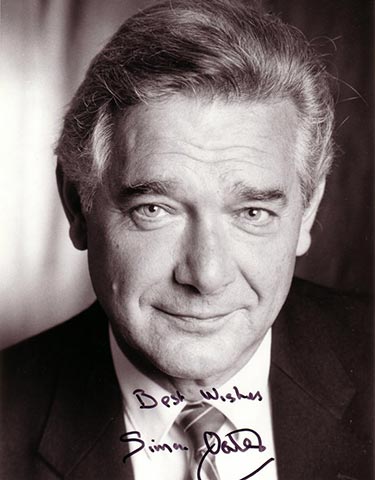
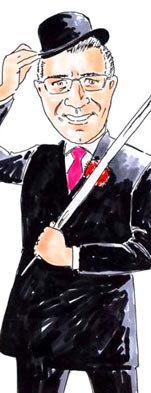
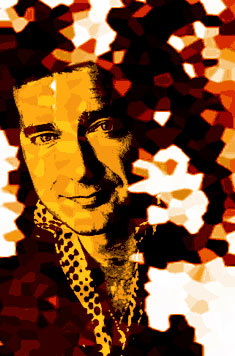
Simon Oates played John Steed in the short-lived stage production
of The Avengers. Best known as John Ridge in the BBC's
environmental thriller series, Doomwatch, Simon Oates enjoyed a long
and celebrated career in the performing arts. He made his popular
breakthrough in the BBC thriller series, The Mask of Janus and the
Spies, before making memorable guest appearances in The Three
Musketeers and several ITC
series, appearing alongside such luminaries as Jeremy Brett, Peter Wyngarde and
Richard Bradford. He also guest starred in The Avengers episodes, You
Have Just Been Murdered and Super Secret Cypher Snatch and, in The
New Avengers, Hostage.
On Saturday 1st November
2008, Simon and his lovely wife Jaki kindly welcomed Alan and Alys
Hayes of The Avengers Declassified into their home in East Sussex to
conduct the following interview.

Maybe we should start off with
your earliest days in acting, Simon. How did you get your big break in the
profession?
"I was at Drama School and we were
invited to be in a Mystery play at the Everyman with Robert Eddison. I
was seeing a girl at the time who was actually a pro actress. She was
working at Chesterfield for Gerry Glaister, who became a big TV
producer and director, and she met me and saw this, knowing I wanted
to turn pro. Her father, who was very wealthy, had arranged for her to
have her own repertory company for a period of time. She said, 'I'll
tell you what, you were my leading man in my company, and I'll give
you a list of the plays that you did', which of course I hadn't done
at all! She went back to Chesterfield, where she was a juvenile lady,
met Gerry and recommended me to him. He took her word for it and so I
started in Chesterfield on 18th July 1954 in a play called Someone
at the Door. I went up there as a fully fledged actor only having
done amateur stuff before, but I blagged my way through it and that's
how I started. Fortnightly rep at Chesterfield, York, Birmingham and
all over the place in various rep companies."
Did you find rep gave you a
strong grounding in the business and helped you later when you came to
work in television and film?
"Totally. You had a week to learn
your lines and moves, then you played them. When you were playing
them, you were rehearsing the next week's play. You were in rehearsal
at ten o'clock until five o'clock, then on stage at half past seven.
When you went home, you learned the next day's act, which used to take
me until about one in the morning. It was hard, but if you could do
it, you could do it. But it was, obviously, great experience for a
young actor. If you've done four years or so in rep, nothing can
happen on stage that you hadn't already had to deal with in that
learning curve. As for television, I treated it exactly the same,
except I didn't have to talk so loud to reach the back of the
gallery!"
Did you have a particular
approach to acting?
"I wasn't a method actor, I was a
me actor. I remember doing one rep show and I went on and tried to
play myself. I'd thought about all the big stars. If you saw John
Wayne, you wanted to see John Wayne. When you went to see the stars,
they were who you wanted to see. The character they were playing may
have been interesting, but you went to see the man. So, I realised
that if I'm the leading man in the rep, the audiences are coming to
see me in this, playing this part, so I thought it was a good idea to
play myself and as far as possible, that's what I've always done."
Has this policy ever made
approaching any particular role difficult, if there were parallels
with your real life?
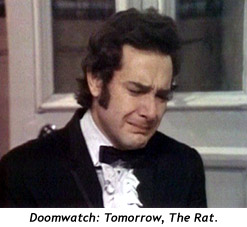 "The one part ever where I had a
hard time of it for this reason was in a Doomwatch programme.
At the time, my father was dying and I had to leave for a couple of
days to be with him. Coincidentally, the storyline for that particular
episode replicated that situation and my character's father was dying,
too. I said to the producer, Terence Dudley, that I couldn't do the
scene until it was all over and asked if we could shoot that scene
last. Terry understood and agreed to it. So, we shot that scene last.
I did it, got it out of the way, and was cuddled away to my dressing
room. I knew I couldn't have done it until then. Another Doomwatch
that was tough for me was Tomorrow, The Rat. It was about
mutant rats that had become super-intelligent and there was one scene
where I had to go and find the woman who I'd been having an affair
with, dead on the floor from all the rat bites. Again, I said to Terry
that it was a scene I couldn't possibly do twice — and so we did it
just the once. Certain things are so close that it's so difficult to
recreate or live with them. I know I may sound like an over-the-top,
farty old actor when I say that, but you know what I mean." "The one part ever where I had a
hard time of it for this reason was in a Doomwatch programme.
At the time, my father was dying and I had to leave for a couple of
days to be with him. Coincidentally, the storyline for that particular
episode replicated that situation and my character's father was dying,
too. I said to the producer, Terence Dudley, that I couldn't do the
scene until it was all over and asked if we could shoot that scene
last. Terry understood and agreed to it. So, we shot that scene last.
I did it, got it out of the way, and was cuddled away to my dressing
room. I knew I couldn't have done it until then. Another Doomwatch
that was tough for me was Tomorrow, The Rat. It was about
mutant rats that had become super-intelligent and there was one scene
where I had to go and find the woman who I'd been having an affair
with, dead on the floor from all the rat bites. Again, I said to Terry
that it was a scene I couldn't possibly do twice — and so we did it
just the once. Certain things are so close that it's so difficult to
recreate or live with them. I know I may sound like an over-the-top,
farty old actor when I say that, but you know what I mean."
You've directed a very large
number of productions for the stage. Did you ever entertain the
thought of doing likewise in television or film?
"No, not really. I like the freedom
of directing on stage and I've had dancers and singers, actors and
technicians working with me. It used to get bloody noisy sometimes and
I'd boom out, 'one voice and it's mine'! Instant silence! They all
realised I knew more about most things than they did — even on the
technical side. I knew what I was doing and I liked the control. On
the stage, it's one man's view. If it's bad, you get the blame and if
it's good, the cast get the credit. Well, there you go… That's the way
it works, but it's got to be as seen in one man's eyes. What you put
on is what you are seeing, and you can't blame anyone else for what
happens. I like that very much. I've been very lucky with the things
I've directed. I directed Joseph and the Technicolor Dreamcoat
and played the narrator a number of times and my production is still
playing today in various places. I loved it."

How did you make the move into
television, and can you remember anything about your early work in the
medium?
"Well, I came down South and it
kind of happened. I can't really remember a lot about my early
television work. I did a couple of Armchair Theatre plays.
Sydney Newman really had a grip on TV drama. Single plays like those
were so beautifully done. They had the choice of who they wanted
because they were so well thought of. They were very, very
professional and I loved every moment of them. You were working with
mates most of the time, too. You knew everybody and you were all
aiming for the same thing."
In the mid-Sixties, you were a
regular in the television series, The Mask of Janus and its
sequel, The Spies. Do you feel these series were a landmark in
your career?
"I think so. I look back on them
with enormous gratitude. They were very important for me. At that
time, I first realised just what fame means. You've got a company of
regular actors including Peter Dyneley and Dinsdale Landen, and you're
rehearsing at the Acton Hilton — as we called the BBC's rehearsal
rooms in Acton — and recording them. You're walking about and someone
might recognise you from something, but once the programmes go out on
air, you just can't go out. You can't go on the Tube, can't get on a
bus because suddenly it's instant recognition — 'ooh, it's 'im!'. It
became very embarrassing. People would come up to you, want to talk,
want autographs. I was in the Army & Navy Stores at one point, buying
something, and all the girls I could see had sussed me, but the woman
who was in charge of the department knew my face and thought she knew
me — but of course, she didn't! We had this long conversation — I
asked her how her mother was. She thanked me for asking. I enquired if
her mother had the same old trouble, because all mothers have the same
old trouble, don't they? So, she told me about that and said how nice
it had been to see me. I said it was nice to see her too, asked her to
give my love to her mother, and walked out. I stopped for a moment and
saw the girls were telling the woman who I actually was. That was
quite good fun."
Around the same period, you were
also making guest star appearances in several filmed series — Ghost
Squad, Man in a Suitcase, The Avengers,
Department S and Jason King. These series are still popular
nearly fifty years later. Did you feel they were anything special at
the time?
"They were solid entertainment and
you did them as well as you could, but you were a working actor. You
were just doing a job. You didn't think it was going to last forever.
It's not as grand as people think it is. I think there was a bit of
prestige about them, but I'd be thinking, 'I've got a job' — and that
was my motivation. What you do is go there, say the lines and don't
bump into the furniture as Noel Coward said."
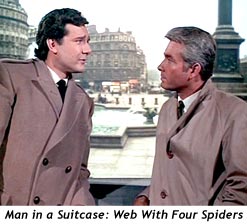 In
the Man in a Suitcase episode Web With Four Spiders,
your scenes are almost exclusively with the series star, American
actor, Richard Bradford. Bradford was famously an advocate of the
controversial
Stanislavski 'method' approach to acting.
How did you find acting opposite Bradford or other performers who
would immerse themselves in their roles? In
the Man in a Suitcase episode Web With Four Spiders,
your scenes are almost exclusively with the series star, American
actor, Richard Bradford. Bradford was famously an advocate of the
controversial
Stanislavski 'method' approach to acting.
How did you find acting opposite Bradford or other performers who
would immerse themselves in their roles?
"They played their game, I played
mine. I just behaved and they acted. And boy did they act! They acted
all over the studio and I just stood there and did my bit. I didn't
want to join in, because for me, less is more. You don't need to emote
all over the stage to get the emotion across to people. It's all in
the eyes, all up there, in the mind. That may sound pretentious, but
it's true. If they want to act out of every orifice, fine, if it works
for them. It just wasn't my scene."
You also worked with Peter
Wyngarde on his two starring vehicles for Lew Grade's ITC,
Department S and Jason King. What are your memories of
working with him?
"Of what we did, knowing my memory,
not a lot until I see them again, but working with him was a pleasure.
He was a lovely, lovely man. Of course, he was gay. We all knew that.
So what? But he had a country house and he called it 'Camp Cottage',
which always gave me a bit of a laugh. A beautiful man, inside and
out. Speak as you find. We got on terribly well together. And the
ladies loved him. What a waste! I almost wish I was gay — I mean, who
wouldn't?"
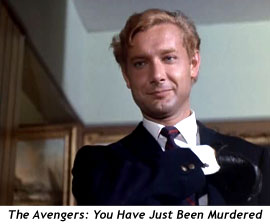 You also did a couple of
episodes of The Avengers. In your first, You Have Just Been
Murdered, you played a silent assassin, who before committing the
deed, would convince his victims that they were exceptionally easy to
kill… How do you approach a role without dialogue? You also did a couple of
episodes of The Avengers. In your first, You Have Just Been
Murdered, you played a silent assassin, who before committing the
deed, would convince his victims that they were exceptionally easy to
kill… How do you approach a role without dialogue?
"Who needs dialogue? You do it with
your demeanor, your body, your eyes and your face. You can terrify
someone, without pulling faces or anything. You can make them think
all sorts of things through the simplest of techniques. A good actor
can make you feel all sorts of emotions, just with eyes and simple
movements. Marcel Marceau didn't have too many lines — and he worked!
You don't always need verbiage to make a point — unless you're doing
Shakespeare, of course. You couldn't stand there all night as Hamlet
and say 'you know what I'm thinking?' of course. It worked for me
anyway, with my sort of acting — which is non-acting, really."
Later in your career, you went
on to appear in series like The Professionals, Remington
Steele, Bergerac and other genre shows. Do you feel that
you were suited to light-hearted thrillers and were you concerned
about being typecast in that sort of show?
"I wouldn't have minded at all. I'm
a light-hearted sort of person! I'm not a dour type who says give me
something serious to do for Christ's sake… Comedy is so much harder
than doing it straight. Anyone can go on and scowl, but it's harder to
do a scene with a twinkle in the eye. It's worked for me. The
Bergerac I did has been shown so many times… It's always on some
channel somewhere. People at the club I go to know the dialogue in
that episode more than I ever did. I played a villainous businessman
on Jersey and there's a scene where I'm in an inflatable armchair in a
swimming pool. We were filming and the inflatable got a puncture. I'm
saying my lines and slowly going down like the Titanic! Good times…"

Doomwatch is probably the
series for which you are best remembered today. It was a popular
series, often uncompromising and challenging. Did you enjoy working on
the series and did you realise then just how ahead of its time it was?
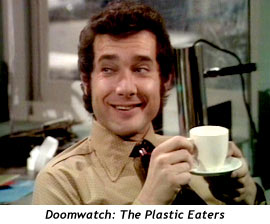 "It was a total delight. The
creator, Kit Pedler, was a genius. Doomwatch was science fact,
totally science fact. Obviously, we told stories, but they were always
based on what could and often did happen in the fullness of time. I
can remember one where we had a man out in space at the same time as
an American astronaut was actually zooming around up there. We'd do a
scene, then go down and put the radio on and listen to what was going
on. It was practically happening at a parallel to what Kit had written
— and then our one died and we got a bit worried. Was this an
indication of what was going to happen to the real one? Of course, it
didn't happen and he was alright, but that was very close to reality.
Kit Pedler saw so far ahead in some of the things that he did, he was
practically clairvoyant. A brilliant mind… I trusted him implicitly —
in fact, we all did. He was a lovely, lovely man. Very clever and very
nice. You felt safe in his hands. We had a very strong team too — John
Paul, Robert Powell, Joby Blanchard and others.
Doomwatch was a joy — and that really was when you couldn't go out
in public! Sure, it was nice to be well known — of course it was nice!
People often say that they get so bored with being recognised — not
me. I was delighted!" "It was a total delight. The
creator, Kit Pedler, was a genius. Doomwatch was science fact,
totally science fact. Obviously, we told stories, but they were always
based on what could and often did happen in the fullness of time. I
can remember one where we had a man out in space at the same time as
an American astronaut was actually zooming around up there. We'd do a
scene, then go down and put the radio on and listen to what was going
on. It was practically happening at a parallel to what Kit had written
— and then our one died and we got a bit worried. Was this an
indication of what was going to happen to the real one? Of course, it
didn't happen and he was alright, but that was very close to reality.
Kit Pedler saw so far ahead in some of the things that he did, he was
practically clairvoyant. A brilliant mind… I trusted him implicitly —
in fact, we all did. He was a lovely, lovely man. Very clever and very
nice. You felt safe in his hands. We had a very strong team too — John
Paul, Robert Powell, Joby Blanchard and others.
Doomwatch was a joy — and that really was when you couldn't go out
in public! Sure, it was nice to be well known — of course it was nice!
People often say that they get so bored with being recognised — not
me. I was delighted!"
Did the attention ever turn
nasty or unpleasant?
"Only about one per cent of the
time. I've always treated everybody I met as a friend. You get what
you give in life, I say. It's always seemed to work for me, and that's
how I've been through life. I've not had many confrontations at all."
Dr John Ridge, your character in
Doomwatch, had what would today be called a character arc. It
developed throughout the series, culminating in Ridge becoming
mentally unhinged and threatening the world with phials of anthrax.
The series creators, Kit Pedler and Gerry Davis, distanced themselves
from this storyline, claiming it had moved too far from the series
intent. Do you remember the controversy and how did you view these
developments?
"There was conflict between Terry
Dudley and the writers at that time. I think the storyline went a
little beyond credibility. It was leaning a bit more towards Doctor
Who than Doomwatch really, and I do remember thinking,
that's it, it's going to go into fairyland quite soon. When people run
out of ideas, they start looking for hooks to hang things on and
that's what they did. I was so proud of what we'd done in Doomwatch
that I didn't want to be involved with something that might be
going a little bit under-par."
Despite that, the storyline
prompted your face to be emblazoned across the cover of Radio Times
magazine. How was it going into the local newsagent's that week?
"It felt marvellous. I mean, can
you imagine, walking in and there you are, everywhere. It's got to
feel good, hasn't it? Let's be honest. It was lovely. A bit of a shock
to the system, but part of the game. You get lucky, you get the front
of the Radio Times once in a while. Not many people have done
that. I did once get a letter from Who's Who, asking if I
wanted to be listed in their publication. I jokingly sent them a
letter back. I couldn't resist asking them, why, why?"
Shortly after the series
finished, a feature film of Doomwatch was produced, but your
colleagues and yourself were relegated to cameo roles. How did this
come about and did you find it a disappointing experience?
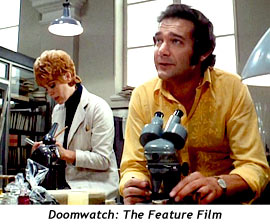 "I didn't want to do it. I hadn't
seen a script or anything like that, but I didn't think it would work.
I was actually working around about that time, in any case, so I said
I couldn't possibly do it. They then came back and offered me silly
money to be in it. Not long after, I realised that we'd been shafted.
They'd cast Ian Bannen — a lovely man, who I liked very much — to play
what was basically my part. It cost them… but I was ashamed that I
gave in to the money. I should just have said no, because it was a
terrible film — a really crap film. But I did. No, not one of my most
favourite episodes. We were shafted, basically." "I didn't want to do it. I hadn't
seen a script or anything like that, but I didn't think it would work.
I was actually working around about that time, in any case, so I said
I couldn't possibly do it. They then came back and offered me silly
money to be in it. Not long after, I realised that we'd been shafted.
They'd cast Ian Bannen — a lovely man, who I liked very much — to play
what was basically my part. It cost them… but I was ashamed that I
gave in to the money. I should just have said no, because it was a
terrible film — a really crap film. But I did. No, not one of my most
favourite episodes. We were shafted, basically."

 After the first year of
Doomwatch, you won the role of John Steed in the stage production
of The Avengers. Was this a role that you were particularly
pleased to get? After the first year of
Doomwatch, you won the role of John Steed in the stage production
of The Avengers. Was this a role that you were particularly
pleased to get?
"I was totally delighted to get the
role. However, when they asked me to do it, I made a point of ringing
Patrick Macnee, not least because Pat is a great friend of mine. I was
thinking that there might have been something devious going on. Were
they trying to blackmail Pat into accepting the role, using me against
him? Were they saying to him that if he wouldn't do it, we can easily
get someone to take the role off you — we don't really need you. I was
concerned because, after all, it was his show. So I rang him and
explained the situation. 'I just couldn't do it,' he said. 'It's too
energetic for me, so do it with my blessing and thank you so much for
ringing.' So I did it… and Pat was right, it was a pretty energetic
show. But Patrick Macnee — what a hard act to follow…"
Did the production turn out
quite as you had expected?
"No it didn't. It could have been
fantastic, but it was sabotaged from the inside. Had I been able to
direct it as well as play in it, it would have run for a couple of
years, I promise you. So many things went wrong. I remember pushing
that Bentley off stage at one point, when it didn't work, and there
was a sofa that was designed to make people disappear through it. I
remember saying that it could be very dodgy and one night, Jeremy
Lloyd got stuck halfway through it. So, I went down and sat in front
of him. I told him to keep still. Most of the audience didn't realise…
I'm sitting there and he's hiding behind me, trying to work his way
through the back of the sofa! Then, in several performances, the
parachute prop came down and got stuck halfway. It would have been so
easy to fix those problems, to make them work. I know all about the
stage, presentation, lighting and everything and I knew after four
days with the director, who shall remain nameless, that we were going
to get screwed up — and screwed up we got. We were carrying too much
on our shoulders. You weren't only aware of what you were doing and
what you were trying to present, but you had your eyes going around
wondering what was going to go wrong next."
Would you agree perhaps that the
ten days you had in Birmingham was too short a preparation time before
the big 'off' in London's West End?
"Totally! Not long enough. We
couldn't possibly have got the thing together in that time. If I'd
been directing, I'd have thrown the furniture about a bit and would
have got it right. It needed time but they'd booked us in and allowed
us just this tiddly running-in period in Birmingham — and I knew then
that we were on a duffer. It was like a car that was half finished.
Are the gears going to work? The brakes? You're not quite sure. We've
not tested that, no, we've not done that either. It was chaotic. I was
disappointed, but I sort of expected it really. The flow of the piece
was being interrupted all the time by things going wrong. That's my
opinion. I think my performance was alright, but then I would think
that! But we just kept getting hitches, hold ups, things going wrong.
You could feel it coming…"
How do you think the play would
have improved and evolved had it have had a longer run?
"Well, it wouldn't have had a
longer run the way it was. Had it have been improved in production and
everything was running right, it could have run for as long as it was
viable to keep it running. It was actually a good fun show with a
decent script, but it's like a stand-up going on stage and having
audience members falling out of the balcony every ten minutes, or
having the microphone or the lighting failing on them… They're not
going to get many laughs with all that happening. You're always
waiting for the next bomb to go off. I know I was, wondering what was
going to happen next and there I am, trying to play John Steed! It
wasn't easy."
The show received some scathing
press. How did the cast and yourself react to this criticism?
"You know what? I never used to
read notices until I'd been in something for about three or four
weeks. Honestly, with my hand on my heart, I've never read a notice
about the Avengers show. I know you've mentioned a couple of
rotters, but fine. They didn't affect me because I didn't know. I
don't tend to believe them if they say I'm good, any more than I do if
they say I'm rotten! No, it wouldn't have worried me. I think every
critic's column should have a little by-line that says, 'one man's
opinion'. There was probably a lot of, 'who does he think he is,
trying to follow Pat?' — and that's understandable because Pat's a
lovely man who gave lovely performances as Steed. So, in a way, I was
on a hiding to nothing before I even started, wasn't I? You think of
great performances people have given and someone has to try and follow
them, and you know they'll never be considered as good as the
original."
It works the same way with James
Bond, doesn't it? Whoever comes along and plays the part, they'll always
be compared to Sean Connery, won't they?
"That's right. Actually, there's a
story here. I nearly got the James Bond role in 1971 and missed out on
it, unluckily, because Sean came back and decided to do one more! I
did the audition and got a round of applause from everybody in the
studio. They were all very pleased and things looked very positive.
Cubby Broccoli was talking terms with my agent — and then one day, he
telephoned me. 'Sorry, Simon. Sean's coming back,' he said. I
understood. Connery was Bond and if he wanted to do it again, they
really couldn't turn him down in favour of Simon Oates, could they?
Sean gave his money to the Highlands and the Islands — and why not —
his choice. When the next one came up, I was working, so I lost Bond — I couldn't do it. Mind you, the way my life's gone, playing Bond would
have changed the course of it and I wouldn't be where I am now. In the
end, I'm grateful that I didn't do it. I've had a smashing career and
I've got the loveliest lady in the world. I'm very happy."
A few years later, you were back
in The Avengers fold, in The New Avengers. What memories
do you have of working on that one?
"Not many! Sometimes, things that
I've been in have been on the television and people ask me how it
ends. I can never remember… I've seen programmes on telly where I've
done scenes with people I can't even remember having met! The mind's
going… You know how it is when you get to twenty-seven… It starts
falling away,
doesn't it? You've got a lot of people coming through, you're doing
lots of different things and then years later, you think, I know that
person… worked with him, worked with her, but in what? I've done quite
a body of work in my time, so it's not surprising that I can't
remember all of it, really? But going back to The New Avengers,
what I do remember are the people — Pat, Joanna, Gareth… I like those
people so much. It was a joy. I loved it."

Another string to your bow is
that you've done stand-up comedy, something that probably not many
Avengers or Doomwatch fans are aware of! How did you get
into that area of showbusiness?
 "Well, it was fairly early in my
career. I'd done some television and was quite well known, but I'd
always wanted to be in a position where I could do it on my own — and
apart from doing solo stage shows, I thought I'd like to have a go at
comedy. So I worked out an act that would run about ten minutes, with
various jokes and sections where I'd go from this subject to that
subject to another — and my friend Arthur White and I went off to The
Deuragon Arms in Hackney. It was a well-known pub and Lenny Bruce had
compered there. They had open nights where anyone could get up and
have a go. I took a look and there was a comic on stage, dying a
death. I went straight to the loos and threw up! I came back and said
to Arthur that I thought I was really getting the feel of it now, and
that when we came back next time, I'd do it. Arthur took me to one
side and told me that I was on next! So the compere says, 'Ladies and
gentlemen! You've seen him here many times before…' — you lying…, I
thought… 'Charlie Barnett, the Cockney Comic!' So I'm up there, and I
get going… I've got a pint in one hand and a cigar in the other. I'm
doing my routine and I'm getting lots of laughs and lots of applause.
I was thinking that this was a bit of alright and suddenly I noticed
Arthur at the back, waving madly at me. I'm a bit confused now. I
didn't think I was doing that badly. I thought I was going down well.
Anyway, I brought it to an end, got a nice round of applause and went
off to see Arthur. 'What did I do?' I asked. 'Forty minutes!!!' he
replied, exasperated. I had been up there for forty minutes. The ten
minute act I'd worked out in my front room had greatly expanded, what
with the punters coming in with their lines, and so on and I just
hadn't noticed. There had been other acts waiting to go on, too! I did
a lot more in the pubs, got noticed and then I was booked to do Sunday
night stage shows and I ended up working with Dorothy Squires at the
London Palladium a couple of times. I also did a little tour with The
Rolling Stones. I just loved it. There were no lines to learn as such
doing stand-up — you've got them in your mind. You know where you're
going. If the audience says something, you follow that hare and then
something follows from that." "Well, it was fairly early in my
career. I'd done some television and was quite well known, but I'd
always wanted to be in a position where I could do it on my own — and
apart from doing solo stage shows, I thought I'd like to have a go at
comedy. So I worked out an act that would run about ten minutes, with
various jokes and sections where I'd go from this subject to that
subject to another — and my friend Arthur White and I went off to The
Deuragon Arms in Hackney. It was a well-known pub and Lenny Bruce had
compered there. They had open nights where anyone could get up and
have a go. I took a look and there was a comic on stage, dying a
death. I went straight to the loos and threw up! I came back and said
to Arthur that I thought I was really getting the feel of it now, and
that when we came back next time, I'd do it. Arthur took me to one
side and told me that I was on next! So the compere says, 'Ladies and
gentlemen! You've seen him here many times before…' — you lying…, I
thought… 'Charlie Barnett, the Cockney Comic!' So I'm up there, and I
get going… I've got a pint in one hand and a cigar in the other. I'm
doing my routine and I'm getting lots of laughs and lots of applause.
I was thinking that this was a bit of alright and suddenly I noticed
Arthur at the back, waving madly at me. I'm a bit confused now. I
didn't think I was doing that badly. I thought I was going down well.
Anyway, I brought it to an end, got a nice round of applause and went
off to see Arthur. 'What did I do?' I asked. 'Forty minutes!!!' he
replied, exasperated. I had been up there for forty minutes. The ten
minute act I'd worked out in my front room had greatly expanded, what
with the punters coming in with their lines, and so on and I just
hadn't noticed. There had been other acts waiting to go on, too! I did
a lot more in the pubs, got noticed and then I was booked to do Sunday
night stage shows and I ended up working with Dorothy Squires at the
London Palladium a couple of times. I also did a little tour with The
Rolling Stones. I just loved it. There were no lines to learn as such
doing stand-up — you've got them in your mind. You know where you're
going. If the audience says something, you follow that hare and then
something follows from that."
Are there ways of learning the
craft of stand-up or is it a case of finding your own way?
"Like we've said about acting — if
you can do it, you can do it. It ain't clever. If you've got that gift
— and it is a gift — you can do it. You can't learn to be a stand-up.
You can watch people, but you have to have the gift. Geniuses like
Paul Merton and Ken Dodd have it. Actually Ken Dodd… The greatest
moment in my theatrical life! I went to see Ken with a friend of mine,
Ross Taylor, who wrote Charlie Girl. He did lots and lots of
work and was very well known. Now, I'd seen in Ken in shows and even
tried to nick his material… only you can't nick his material because
it's so 'him'. It doesn't really work for anyone else. Well, we went
round to the dressing room, and Doddy's there. Ross introduced me and
before he'd even finished speaking, Doddy called me over. 'Simon!' he
said. 'Yes?' I replied. 'Call me Doddy and come over here. Do you mind
if I have my photograph taken with you?' — now how do you top that in
anything you do in the business? What a lovely man. That just blew my
mind — the fact that he actually knew me. You don't think about that,
do you? 'Do you mind if…!' I thought, I'd have paid you for this!"
"Another great moment… I was doing
a tour and was at the Theatre Royal, Brighton, and had the number one dressing
room. When I was in the Army — I was in the Intelligence Corps — I
used to go there and I saw some of great actors there. I'd seen Paul
Schofield and John Gielgud, and they had had that dressing room. It's
got its own loo, you know, a wooden seat loo — and I went in there one
night and thought, this is where Gielgud and Schofield sat! Another
magic moment — a picture with Doddy and a dump where the they had sat!
That's it, isn't it? Follow that with the sea lions!"

You've retired from showbusiness
now. How do you view the industry as it is today, now that you're back
to being a member of the audience?
"As I'm not in the industry today, I'm not really in a position to
make comments, but what my wife Jaki and I are really impressed about
at the moment is the standard of acting on British television. I think
it's got to be the highest standard in the world. Even small parts in
things are so beautifully done that I just sit back with admiration.
Total admiration because they're all so bloody good. And I'm delighted
to see that."
Do you find it disappointing that so much television is lost or
missing today from the era when you were most prolific in the medium?
"I think it's a shame but there are bigger things in life than losing
bits of television series. You have to question the mentality, of
course, of whoever it was who said they needed the space, or that that
programmes didn't need to be kept. So many great programmes were just
wiped. Heads needed looking at, really. Not for my stuff in
particular, of course, but for the business as a whole. So many people
like to watch old movies, after all. I think it's a great shame. It's
almost like saying that this Rolling Stones record has been out for a
while, so let's get rid of it and we'll stick out something new
instead. It's the same sort of principle really — people didn't just
wipe famous music recordings. So… why? That's not a personal thing,
it's just a general view of how the business operated in those days."
Looking back on your career, what would you pick out as the
highlights, the roles that meant the most to you?
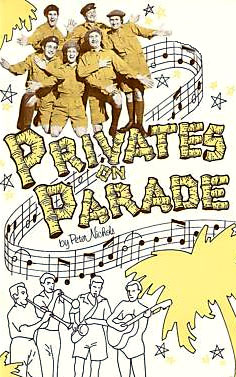 "Obviously, I liked Doomwatch for what it did, and I enjoyed working
on The Spies and The Mask of Janus. Many other things, too. But my
favourite was definitely the stage show, Privates on Parade. That was
beautiful. I played Captain Terri Dennis and I absolutely, totally,
totally loved it. I would say that if I wanted to be remembered for
anything, that'd be it. Yeah. That was me." "Obviously, I liked Doomwatch for what it did, and I enjoyed working
on The Spies and The Mask of Janus. Many other things, too. But my
favourite was definitely the stage show, Privates on Parade. That was
beautiful. I played Captain Terri Dennis and I absolutely, totally,
totally loved it. I would say that if I wanted to be remembered for
anything, that'd be it. Yeah. That was me."
"But I've been so, so lucky.
I've not had any disasters. I don't accept The Avengers as a
personal disaster because as I say, it could have been avoided. I was
stuck in the middle of it, but you can only do your best and try to
pull it out of the mire. Had we have had more time, it wouldn't have
gone into the mire in the first place, but there you go. It was like
being the Captain of the Titanic. You can arrange the deck chairs as
best you can, but it doesn't make much difference when you're
sinking."
"No, I've had a life to die for.
I've had ups and downs personally, just like anyone, but I couldn't
have asked for a more satisfying life than the one I've had in
theatre, television and film. I've been so lucky and I'm so grateful
to have had the opportunity."
At the time of this interview in
November 2008, Simon was undergoing treatment for a long-term serious
illness. Sadly,
Simon succumbed to cancer a mere six months later on Wednesday
20th May 2009. Alys and I were
devastated to hear the news — Simon was a delightful, witty and above
all, generous and kind man, and the world is worse off by far without him. Our heartfelt condolences to his wife Jaki and their family and
many friends. The day we spent with them both was a highlight of our year
and we will remember that day and Simon and Jaki with great fondness
and admiration for many years to come.
Interview conducted by Alan
Hayes and Alys Hayes
Edited for
publication by Alan Hayes
Digital Art by Alan Hayes
The Friendly Avenger —
Simon Oates Tribute
Back to Top |