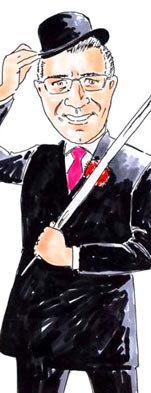
|

The Avengers has enjoyed
considerable success around the world since it hit British television
screens in 1961. At its height, it was a major hit on the American
networks and is still highly thought of to this day. In its time (and
beyond it), the series gave birth to many spin-offs, including books,
comics, audio adaptations, a stage play and even a Hollywood movie. However, of these
'children' of the series, the brightest in the class for us has to be
the South African radio series, broadcast in that country in the early
1970s.
Radio is a difficult medium —
characters and narrative must be delivered in sound alone. On
television, this is disseminated to viewers through dialogue, action
and a wealth of visual pointers. We are shown home and work
environments, modes of dress, mannerisms and so forth. On the radio,
performers have just their voices and that of the narrator with which
to impart equal detail. The consummate ease with which this was
accomplished on The Avengers is the mark of a group of
experienced and highly skilled radio performers and 'backroom' staff.
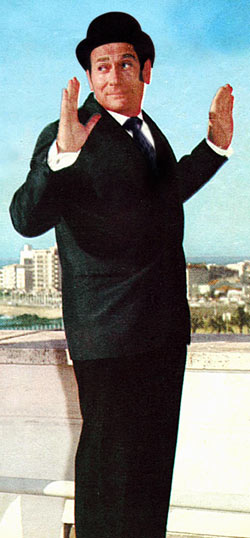 Donald Monat simply excelled as
Steed, and is undoubtedly the nearest anyone has come to equalling
Patrick Macnee's definitive portrayal. From the very first scene you
hear, Monat immediately stamps his mark upon the role. Any previously
held notion that John Steed can only be played by one man is instantly
disproved. Monat's interpretation, which gives the impression that his
Steed is, perhaps, a little older than Macnee's, is highly effective.
His distinctive voice lends John Steed an instant authority — a highly
desirable piece of radio shorthand. Unlike with the unfortunate Ralph
Fiennes in the 1998 Warner Brothers movie, The Avengers, the
audience has no difficulty in accepting Donald Monat as John Steed.
Just as with Macnee, Donald Monat is John Steed — no question about
it. Donald Monat simply excelled as
Steed, and is undoubtedly the nearest anyone has come to equalling
Patrick Macnee's definitive portrayal. From the very first scene you
hear, Monat immediately stamps his mark upon the role. Any previously
held notion that John Steed can only be played by one man is instantly
disproved. Monat's interpretation, which gives the impression that his
Steed is, perhaps, a little older than Macnee's, is highly effective.
His distinctive voice lends John Steed an instant authority — a highly
desirable piece of radio shorthand. Unlike with the unfortunate Ralph
Fiennes in the 1998 Warner Brothers movie, The Avengers, the
audience has no difficulty in accepting Donald Monat as John Steed.
Just as with Macnee, Donald Monat is John Steed — no question about
it.
Diane Appleby's Emma Peel pales
somewhat when compared to her television equivalent, Diana Rigg.
However, to be fair to Ms Appleby, the character of Mrs Peel was never
going to be as simple to transfer from the medium of television to the
radio as that of her partner in crime detection. Steed is an
archetypal figure, whereas Mrs Peel was something very new, and much
of her character was communicated on TV in visual shorthand.
In the surviving recordings — all
but one being Dennis Folbigge adaptations — Emma Peel often appears to
be Steed's assistant, rather than the equal partner she should be. The
depiction of Emma Peel in these later scripts was patchy at best.
Running out of suitable Emma Peel scripts to adapt, Sonovision looked
to the later, Tara King series for further source material. The
substitution of Emma Peel for Tara's part in these stories appears to
have been executed without consideration to character variations
between the two. Consequently, in one serial, such as Train of
Events, Emma would be self-sufficient and practical, while in
Stop Me If You've Heard This — another adaptation from the same
period of the radio series — she is unable even to read a map the
right way up! The character of Tara King seems not to have been
rewritten for Emma Peel, merely renamed. Despite being served poorly
by some scripts, Diane Appleby always did her level best with the
role, and when required, as in The Joker, she could
single-handedly carry the programme with great aplomb.
The contribution of Hugh Rouse,
another regular performer, cannot be underestimated. As the narrator,
Rouse provided an essential link between the other cast members and
the audience, keeping the listener up to speed and ably filling the
gap left by the absence of visuals. Hugh Rouse, every bit as much as
Donald Monat, gives a unique and definitive performance, lending the
radio series a unique identity. Rouse's delivery is superb, dealing
with descriptive, dramatic or comedic passages with equal skill.
Listeners who come to the series via the surviving episodes are sure
to find that his narration will keep them interested in events as they
unfold.
A most rewarding aspect of the
radio series for fans of The Avengers is that in most cases, it
would appear that Sonovision were sent early drafts of the scripts.
Due to this, the radio versions are often at variance with what was
televised. Obviously, some changes were made by Tony Jay and Dennis
Folbigge because parts of scripts did not suit the radio, but others
are clearly the result of working from scripts that were not the
finished article. Clinching proof that this was the case is that
Too Many Olés is set in Spain — the television episode was planned
to be made there, but was eventually shot in Britain (with changes to
dialogue, story title etc) for budgetary reasons. Therefore, the radio
version is definitely the best record we now have of how They Keep
Killing Steed was originally envisaged. From this, we can
reasonably ponder whether the Cybernauts were originally called
Pabulum Robots and would have appeared in a story called A Deadly
Gift, rather than The Cybernauts.
Of the nineteen serials that
survive complete, eleven have titles at variance with their television
forebears. Could these have been working titles, or did Sonovision
title the serials themselves? A matter for conjecture, and one that
makes it doubly sad that the remaining serials are not believed to be
in existence today. They could have been an invaluable reference tool
for researching the finer points of the script-to-screen process,
aside from their general entertainment value to fans of The
Avengers.
It's a crying shame that there
appears to have been no archival mechanism in place in South Africa in
the 1970s to preserve material such as this for the benefit of future
generations. The thirty hours of material that does survive merely
leaves the listener hungry for more...
Written by Alan Hayes and Alys
Hayes
Back to Top |