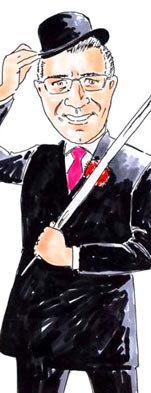
|
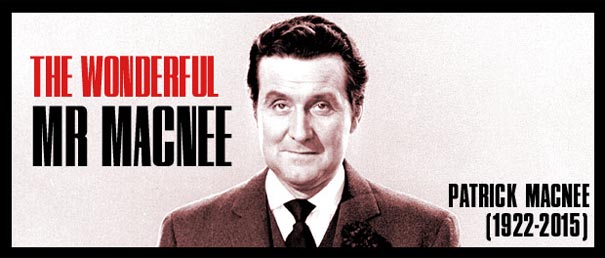
The Avengers Declassified is not
a website that makes a habit of running obituaries or tributes to
actors or production staff when they sadly pass away. This is not to
say that their contribution to the series is in any way unimportant or
not valued by those of us who write for the site; such essays simply
do not fit easily within the site's remit. However, sometimes we lose
people who are simply too important, too tied up in what makes The
Avengers tick, and to whom we simply must devote space. Such a
loss was announced on 25th June 2015 when we lost the series' most vital
cog, the incomparable Patrick Macnee.
When, at 38, Patrick Macnee was
drafted in by ABC Television drama supervisor Sydney Newman and
producer Leonard White to star alongside Ian Hendry in a new series
called The Avengers, no one knew just how instrinsic to the
success of the series Macnee would ultimately be. Both Newman and
White had worked with Macnee during his time at the Canadian
Broadcasting Corporation in the mid-1950s, and consequently he was
viewed as a safe pair of hands, capable of sharing the burden of a
weekly one-hour drama with Hendry.
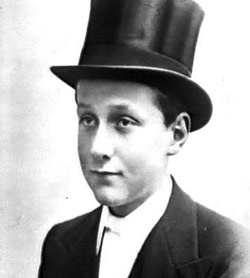 Patrick
Macnee, at that time, was something of a perpetually coming star who
had yet to find a real, breakthrough role. Born in London on 6th
February 1922 into a well-off but dysfunctional family, Macnee spent
most of his youth from the age of five boarding away from home at
public schools. He was placed first at a kindergarten in Minehead,
Somerset, and then at Summer Fields Preparatory School in Banbury,
where he was enrolled for four years. Aged 12, in 1934, he became a
student at the famous Eton College. Patrick
Macnee, at that time, was something of a perpetually coming star who
had yet to find a real, breakthrough role. Born in London on 6th
February 1922 into a well-off but dysfunctional family, Macnee spent
most of his youth from the age of five boarding away from home at
public schools. He was placed first at a kindergarten in Minehead,
Somerset, and then at Summer Fields Preparatory School in Banbury,
where he was enrolled for four years. Aged 12, in 1934, he became a
student at the famous Eton College.
While his time at Summer Fields and
Eton saw the young Macnee become interested more and more in the
theatre and performing, the time spent away from home had a marked
effect on him. "The only time I was home with my mother and father was
during the school holidays. That was the pattern of my life for 12
years. On the credit side, I suppose one is immensely well-educated.
On the other hand, I feel that not to see one's parents for relatively
long periods and to be put into a cloistered educational establishment
away from home — in some cases quite far away from home — for a number
of years, has a devastating effect on your later life. You always feel
you are being sent away and you don't have any sense of family
whatsoever. Educationally, it's very good, but psychologically it has
its hazards," he commented in 1976 when talking to TV Times
magazine.
Macnee credited his initial
interest in acting to the influence of a schoolmaster at Summer Fields
by the name of Allington. Remarkably, this led to him appearing, as a
callow eight-year-old, in a complete and uncut Summer Fields
production of William Shakespeare's Henry V. Macnee was awarded
the leading role, and in one of those wonderful coincidences,
alongside him, delivering his lines confidently in a mixture of
English and French as the Dauphin, was Christopher Lee, a fellow
Summer Fields student. Three decades later they would be reunited when
filming the Avengers episodes Never, Never Say Die and
The Interrogators.
Upon leaving Eton in July 1939,
Macnee initially helped his father, Daniel 'Shrimp' Macnee (so called
due to his short stature), for whom he had a deep affection, training
racehorses at Lambourn, Berkshire. As the world teetered on the brink
of conflict, the Macnees were touring the racecourses of the south of
England in a scarlet 1928 Chrysler two-seater.
From 1940, Macnee trained briefly
at the Webber-Douglas School of Singing and Dramatic Art, to which he
gained a scholarship. He soon abandoned his studies there to join
repertory theatre in Letchworth Garden City, Hertfordshire. That, in
turn, led to further 'rep' in Bradford at the Princes Theatre, working
for the actor-manager Harry Hanson. Macnee then gravitated towards
London's West End, initially as an understudy, and his first offer of
film work arrived.
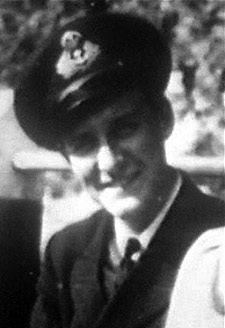 On
the day of his West End lead debut in the summer of 1942, Macnee
received his call-up papers from the Royal Navy. The film role went to
Stewart Granger, and Macnee went as an ordinary seaman for training at
Porthmadog, North Wales. Further instruction followed at Brighton,
Devonport and the Royal Naval College at Greenwich, and Macnee emerged
as a sub-lieutenant. He went on to serve as a member of the Eighth
Gunboat Flotilla, based in Dartmouth, South Devon. On
the day of his West End lead debut in the summer of 1942, Macnee
received his call-up papers from the Royal Navy. The film role went to
Stewart Granger, and Macnee went as an ordinary seaman for training at
Porthmadog, North Wales. Further instruction followed at Brighton,
Devonport and the Royal Naval College at Greenwich, and Macnee emerged
as a sub-lieutenant. He went on to serve as a member of the Eighth
Gunboat Flotilla, based in Dartmouth, South Devon.
Between then and D-Day in 1944,
Macnee took part in patrols of the English Channel. By his own
admission, his was a quiet war, but when things turned for the worse,
providence took a hand, as he explained to TV Times: "The only
time I missed going on a mission the boat was sunk. I'd caught
bronchitis and was in the Chichester Hospital when it happened. I
didn't know about it until I'd reported back to base. A lot of the
crew were killed, but the captain and my replacement survived. It was
extraordinary. I had been on scores and scores of trips before missing
the one that proved fatal, yet the odd result was that it had no
particular impression on me. We were immune to shocks in those days.
We treated it all very casually, which is easier to do when you're in
your early 20s. I was only 25 when I came out of the Navy."
Back
in "civvy street", Macnee tried to pick up the pieces of his acting
career. In 1947, he joined the Four Seasons theatre company, which was
based at the Duchess Theatre in London's West End. The company
included another young actor who would go on to figure large in
Macnee's destiny — Leonard White. Despite a succession of supporting
roles, Macnee came to the attention of Harold Hobson, a Sunday Times
theatre critic, who in the newspaper's 9th March 1947 edition
described Macnee's one-line turn in Webster's The White Devil
as "the most striking moment in a performance in which such moments
are not few." Bit part turns in films such as Laurence Olivier's
Hamlet (1948), The Small Back Room (1949) and Dick
Barton at Bay (1950) led to higher profile supporting roles,
notably in Scrooge (1951), in which Macnee played the young
Jacob Marley. However, life was tough for Macnee and his wife Barbara.
They had two young children, Rupert (born 1947) and Jenny (born 1950),
money was tight, and prospects were uninspiring. Fortune shone upon
the family, however, as an offer came for Patrick to work in Canada,
and although they would be parted by the Atlantic, money was soon
flowing in more healthily and his career seemed finally to be taking
off, as he later revealed: "Incredibly, it seemed, I became a star
almost immediately [in Canada]. I had two series, one after the other:
The Moonstone and an adaptation of a Canadian novel. Suddenly, I was a
big fish in a very small pond, small because the television
transmitter reached only around the Toronto area, so I was only famous
in the city. But for all that, it went completely to my head, and I
felt quite ashamed that there I was, a star — and still living in the
YMCA."
Macnee worked in Canada, almost
exclusively, for the following eight years, taking roles in
television, while occasionally skipping over the border into the
United States of America to appear in filmed television series such as
Alfred Hitchcock Presents, The Veil, Rawhide and
The Twilight Zone.
Sadly, his success on the other
side of the Atlantic had put a strain on his marriage and, although he
returned once in a while to England, for personal and professional
reasons, he and Barbara divorced in 1956.
Eventually, he was drawn back to
Britain in 1960 to work in what was, for him, a very unfamiliar
capacity, as co-producer on the television documentary series The
Valiant Years. This series of 27 half-hour programmes, based on
the memoirs of the celebrated wartime leader, Sir Winston Churchill,
was commissioned by the American Broadcasting Company and proved to be
hugely successful on both sides of the Atlantic.
When approached by Leonard White
regarding the role of John Steed in The Avengers, Macnee was
very much caught up in the critical and popular acclaim that his
newest venture was enjoying: "It was wonderful," he remarked in The
Stage and Television Today of 5th January 1961. "I got such a kick
out of it that I intended to forget acting completely." Macnee was
scaling heights as a producer that he had never really reached in
twenty years as an actor. However, the pay was modest, and he realised
that the role on offer in The Avengers represented an excellent
opportunity for him. After White had convinced him that the part was
too good to miss, Macnee met with Sydney Newman to discuss terms and
struck a deal that amounted to three times his weekly wage on The
Valiant Years.
During the course of the first year
of The Avengers, Macnee gradually settled into the skin of the
John Steed character, after a somewhat shaky start: "I hadn't actually
thought about Steed in any great detail until, after about two or
three episodes, Sydney Newman called me into his office and forced me
to take stock of my position." Newman suggested that the part as
Macnee was playing it was just not working; Steed lacked personality,
and neither the character nor his costume was interesting enough. He
asked if the actor could spend some time thinking how the character
and his apparel might be revitalised. "I was terribly downtrodden to
hear this — I thought that I was doing rather well — and got very
angry and stormed out of his office. Depressed, I went home to my flat
and thought of how I could improve the character, rationalise it, make
it work," Macnee confessed in his second autobiography The Avengers
and Me in 1997. "[My father, Daniel, the racehorse trainer] was a
real dandy. He used to lean over the paddock gate, always with a
beautiful carnation in his buttonhole. He'd wear a cravat with a pure
pearl in it, and wore a lovely brocade waistcoat… Then I 'pinched' a
bit from Sir Percy Blakeney, the Scarlet Pimpernel, one of the great
British heroes. It seemed to me that if Steed was this shadowy person
who was helping to rescue other people, he was something like the
Pimpernel — somebody extremely well-dressed who gave the impression of
being a fop, so nobody felt that he was a threat."
Another source of inspiration was
the 1939 film Q Planes (released in the United States under the
title Clouds Over Europe), and specifically the role played in
it by Ralph Richardson, one of the great talents of the era. His
character, Major Hammond, a British spymaster seeking to discover the
truth about warplanes that had gone missing on test flights, conceals
a keen intellect behind the façade of a buffoon, wears a homburg hat
and carries a furled umbrella — the parallels with Steed are plain.
Macnee has also often credited Bussy Carr, his commanding officer in
the Royal Navy, as a further influence on his thinking when defining
the characteristics of Steed, someone who was, like Macnee's father, a
dandy, and yet courageous.
The likes of Beau Brummell also
sprang to mind. "I thought of the Regency days — the most flamboyant,
sartorially, for men — and I imagined Steed in waisted jackets and
embroidered waistcoats. Steed I was stuck with as a name, and it
stayed. Underneath he was steel. Outwardly he was charming and vain
and representative, I suppose, of the kind of Englishman who is more
valued abroad. The point about Steed was that he led a fantasy life —
a hero dressed like a junior cabinet minister. An Old Etonian whose
most lethal weapon was the hallmark of the English gentleman — a
furled umbrella," he revealed to author Dave Rogers in 1995.
By June 1961, Macnee described
Steed to the readers of TV Times magazine as rather more of a
fantasy figure than he had been before: "Like Steed, I live by my own
rules. I always have. At Eton College I was a gambler, a successful
one because I got tips straight from the 'horse's mouth' — my father,
then very active in the racing business. I had £200 in the kitty when
the authorities caught me. I was nearly expelled. Let's say Steed is a
slightly exaggerated form of myself. Somebody once said to me: 'you
should have lived in the 18th century'. I agree. Like Steed, I'm a
great pretender. Anybody who loves the good life, as I do, has to be a
pretender."
By the time that Ian Hendry decided
to leave the series in early 1962, Macnee's character Steed was
equally as popular with viewers as Hendry's Dr Keel. Consequently, it
was decided to refashion the series with Steed as the central
character.
Macnee's
position at the centre of the show would go on to last for longer than
Macnee could have possibly imagined. The idea that The Avengers
would last out the decade, and then return for a further two years in
the mid-1970s as The New Avengers, was never really a part of
the script. The series and Macnee — ever-present after Series 1 — were
great survivors. However, when production wrapped in March 1969, he
made a clean break from the role that had kept him in the public eye
for more than eight years, as he explained to TV Times in 1976:
"Two days after I finished the final episode of The Avengers in
1969, I left for California and settled in a little apartment. Then I
worked on films in Cyprus [Incense for the Damned] and Malta [Mister
Jerico] and toured Australia and New Zealand in The Secretary
Bird. At first, I got bad reviews in Sydney for the play, and it
worried me. But I worked hard and when we went to Melbourne the
following year, it was an enormous success. Then I was asked to go to
London to take over from Anthony Quayle in Sleuth. I made the
excuse that I was otherwise committed. The truth is I was too scared
to play in the West End in such a role. Even with all my experience, I
didn't feel up to it, especially after all those years working in
television. But after two years I felt ready again, successfully
played in Sleuth [pictured], and enjoyed a 16-month run on
Broadway. I believe Sleuth was my personal turning point as an
actor. I think it made me stronger. For the first time in years, I
realised I could do more than lift a bowler and dash about as Steed."
During this period, Macnee also
found time to make several guest appearances in American television
programmes. His first such role was in the Western series The
Virginian (transmitted 25th February 1970). Before he was recalled
to service as John Steed in The New Avengers (1976 to 1977), he
also featured in episodes of Alias Smith and Jones (1971), Rod
Serling's Night Gallery (1972) and Columbo (1975), and
even an episode of the situation comedy Diana (1973) alongside
his one-time Avengers co-star Diana Rigg.
The New Avengers saw Macnee
teamed with two young actors, Joanna Lumley as Purdey and Gareth Hunt
as Mike Gambit, undertaking missions together in a restyled show that
lasted for two series of 13 episodes. It was a worthy successor to the
classic original, and enjoyed some considerable — if brief — success.
Sadly, a strong first run was followed up with a far weaker second
year, during which the hunt for increasingly elusive funding sent the
series at first to France, then to Canada, and then into cancellation.
Macnee returned to California and
resumed his work in American television, notably in the original
Battlestar Galactica series (1978 to 1979), in which he performed
voiceover work and also appeared as Count Iblis, a character who,
beneath a façade of charm and urbanity, was quite untrustworthy and
more than a little evil! Other series to benefit from his
participation in this period were The Littlest Hobo (1980),
Empire (1984) and — back in England — Dick Turpin (1981).
Feature-film
roles were also in ready supply, the most high profile of these being
in the James Bond film A View to a Kill (1985), playing Sir
Godfrey Tibbett alongside his old friend Roger Moore. He also featured
in prominent roles in another Moore film, The Sea Wolves
(1980), the spoof 'rockumentary' This is Spinal Tap (1984) and
the TV film The Man from UNCLE — The Fifteen Years Later Affair,
in which he played Sir John Raleigh, the new boss of Napoleon Solo
(Robert Vaughn) and Ilya Kuryakin (David McCallum), inheriting the
vacancy left by Leo G. Carroll, who had died in 1972. Macnee was also
involved in a succession of Sherlock Holmes television movies between
1976 and 1993. In the first of these, Sherlock Holmes in New York,
he played Dr Watson to Roger Moore's Holmes, then played the same role
opposite Christopher Lee as Holmes in two productions — Sherlock
Holmes and the Leading Lady (1991) and Incident at Victoria
Falls (1992) — before he himself appeared as the great detective
in The Hound of London (1993), with John Scott-Pagett taking
the role of Watson.
Occasionally, Patrick has revived
the role of Steed, either in commercials such as those for Timex
watches, Ford, Vauxhall and Sterling cars and Laurent-Perrier
Champagne, or in promotional films, including one made with the pop
group Oasis in 1996 (though it is arguable that Macnee's James Bond
role is as much the influence as Steed in this case). Arguably the
most brazen of these often unofficial appearances features in an
episode of The Hardy Boys entitled Assault on the Tower
(transmitted 15th October 1978), in which Macnee played a character by
the name of 'S', who was John Steed in all but name. He also featured
in the ill-starred 1998 Warner Bros feature film The Avengers,
but did not appear on screen as his character was the aptly named
Invisible Jones. Of all the actors trying to scrub the film from their
list of credits, he was, by providence, the one in the best position
to save face, having supplied only his voice!
Macnee remained in demand
throughout the 1990s and up to his eventual retirement in 2003. Major
credits were in television during this time, notably in several
episodes of Thunder in Paradise (1994), a misfiring
comedy-drama series starring wrestler Hulk Hogan, and as psychiatrist
Dr Walton in Night Man (1997 to 1998), a fusion of science
fiction and crime-fighting, which was based on a comic book by Steve
Englehart. Macnee also returned to Britain to film scenes for Rosamund
Pilcher's Nancherrow, a two-part mini-series made by Portman
Productions for ITV, in which he was happily reunited with New
Avengers co-star Joanna Lumley. His final acting role was as Dr
Ballard in The Low Budget Time Machine (2003), a sci-fi spoof
set in the not-too-distant apocalyptic future.
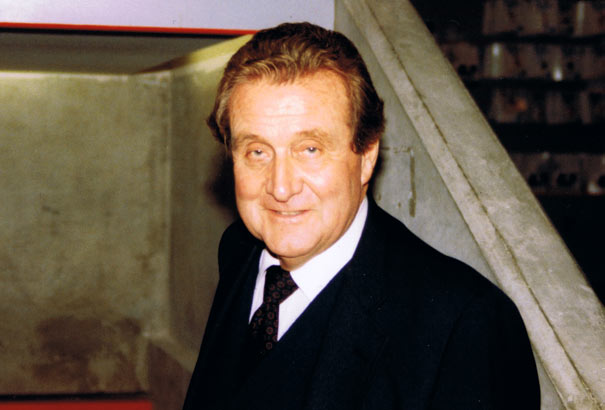
Image: Patrick Macnee at the Museum of the Moving
Image, 29th September 1988 (© Alys Hayes)
Macnee wrote two autobiographies,
Blind in One Ear (Harrap, 1988, with Marie Cameron) and The
Avengers and Me (Titan Books, 1997, with Dave Rogers). He fathered
two children, Rupert and Jenny, from his first marriage to Barbara
Douglas. His second marriage was to Avengers guest star
Catherine Woodville, between 1965 and 1969. He married again in 1988
to Baba Majos de Nagyzsenye. The couple remained together in Southern
California until she passed away in 2007. Patrick continued to reside
there until his own death on 25th June 2015, when he passed away
peacefully surrounded by members of his family.
Although he rarely stopped working
in the years after he had finally left The Avengers behind him,
enjoying success on the stage, television and the big screen, Patrick
Macnee will forever be remembered as John Steed. The series may not
have been set up around him, but his original co-star Ian Hendry, when
interviewed by TV Times in 1976, acknowledged Patrick's
importance in the history, development and ultimate success of The
Avengers: "Although I was the first Avenger, Pat will always be
Avenger-in-Chief."
Due to his remarkable realisation
of the character of John Steed, the name and image of Patrick Macnee
is recognised the world over, more than fifty years after he signed on
the dotted line at ABC Television. His death will be mourned by those
who loved him, be they family, friends, acquaintances or the general
public in hundreds of countries who were lucky enough to be introduced
to Macnee's gentleman agent — the quintessential English fictional
hero of the twentieth century.
Written by Alan Hayes and
Richard McGinlay, 25th June 2015
Back to Top |