|
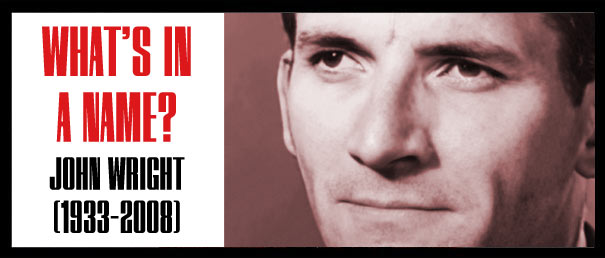
The
name John Wright may not be one that is familiar to fans
of The Avengers, but there can be no doubting that his contribution to
the show's legacy has been considerable. Without John's foresight in
making home recordings of Springbok Radio transmissions, there would
be almost no record existing of the radio remake of The Avengers. The
same can also be said for many other South African radio shows that he
also recorded, as programme master tapes were routinely recorded over
with new productions, often within days of their broadcast, and there
was then no official South African radio archive in existence.
As for the man himself, it
would be exceptionally easy to fall into the trap of regarding John
Wright as no more than a dyed-in-the-wool old-time radio fan, or "the man who saved the radio
Steed and Mrs Peel". He is, after all, featured here at The Avengers Declassified
for those very aspects of his persona, but when I was in contact with him
between 2002 and 2004, it became apparent very quickly that there was
considerably more to him than that. John was a great help to me and
this website, and what follows is by way of my tribute to him.
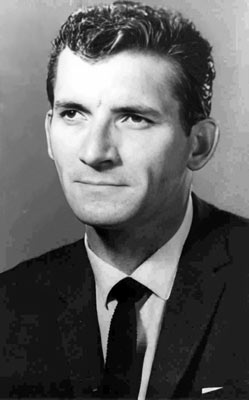
Born in South Africa in 1933, John quit
school early at just 14 without his parents' consent to go and work in a battery factory. He subsequently secured diplomas in
marketing and other business functions, before trying his hand at a
succession of jobs: laboratory assistant, storeman, salesman, private
investigator, nightclub photographer and project specialist. All of
these no doubt gave John an excellent grounding for the next phase:
his career in writing.

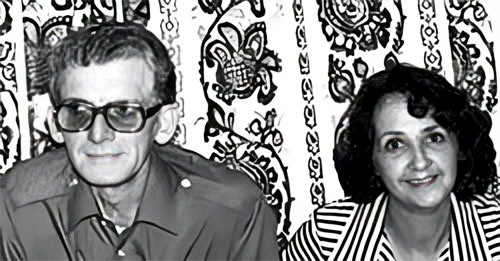
While attempting to break into
writing, John was still working in an office, and had only recently
married his wife, Coral (pictured above, with John). Speaking in 2002, he recalled long, long
days, where he would more than burn the midnight oil... "Often, Coral
never knew what time I'd be home, or sometimes, if I'd be home at all.
It was tough, but interesting, and along the way I met some really
great people. An average day would be: at the office for 8.00am, home
by 6.00pm - perhaps a movie or company at 8.00pm. I'd be free again at
perhaps 11.30pm, then at the typewriter until possibly 2.00 in the
morning - and back at the office at 8:00am!"
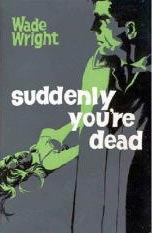
 John's
first published novel, entitled Suddenly You're Dead, a mystery tale
penned under
the nom-de-plume Wade Wright, was published in 1964 by Robert Hale Ltd.
(London) — a publisher to whom John would remain loyal throughout his
writing career. The central character in this novel was Bart Condor, a
tough private investigator in New York City, who would appear in a
further five novels, the last of which was Two Faces of Death,
published in 1970. John's
first published novel, entitled Suddenly You're Dead, a mystery tale
penned under
the nom-de-plume Wade Wright, was published in 1964 by Robert Hale Ltd.
(London) — a publisher to whom John would remain loyal throughout his
writing career. The central character in this novel was Bart Condor, a
tough private investigator in New York City, who would appear in a
further five novels, the last of which was Two Faces of Death,
published in 1970.
"There is no doubt at all that I'd
been influenced by Mickey Spillane and his Mike Hammer. In fact, it
was probably Mickey who really got me started. I'd written to him,
care of New American Library, to say thanks for a lot of very
enjoyable reading. Mickey replied by way of a pretty long letter that
ended with 'Keep writing and make lots of money'. At the time I was
knocking out an occasional article or short story, but that was it,"
John revealed while in conversation with Steve Lewis for the
Mystery*File website in February 2007. One morning, John had
an argument with his manager at work, and decided to take heed of
Spillane's advice. "At lunchtime I drove home and spent two hours
hammering my Olivetti portable, completing the first two chapters of
Suddenly You're Dead. A couple of weeks later I finished it." The
manuscript was sent first to New York and then to London, where the
literary agents London International Press negotiated a sale to Robert
Hale. The contract included first option on John's next three books.
Another series of books, focusing
on a different private eye, Paul Cameron, ran concurrently, and
commenced with Shadows Don't Bleed. The collection, which
included The Sharp Edge drew to a close with The Hades Hello,
issued in January 1973. He also created other characters, including
cartoonist Matt Whitney and Vietnam veteran Calhoun.
In the early years of the new
Millennium, John would make an attempt to return to the Paul Cameron
series. At this time, he worked on a new adventure for the private
eye, but the book was never published.
As public tastes changed, and in
response to a decision taken by his publisher to slow the regularity
of mystery book publication, John turned his attention to a genre
which he had long harboured a love for — the Western. Writing as Ray
Nolan (derived from two men John admired: singer-songwriter and actor
Ray Whitley and Western author Bob Nolan), John had his first novel of this type published in February
1986 — The Dorne Gun, and subsequently wrote eight further
Westerns, with his final entry in the genre being Double Cross
Range (2002).
"Like most boys, I loved the
B-Westerns. Also the pulps such as Fifteen Story Western, Dime Western
and Texas Rangers. So the transition wasn't difficult and I enjoyed
doing them. What I didn't enjoy was an editor trying to maintain
political correctness, oft times even endeavouring to eliminate
references which might be considered even remotely offensive," John
explained in his
Mystery*File interview.
The Wade Wright Library
|
 |
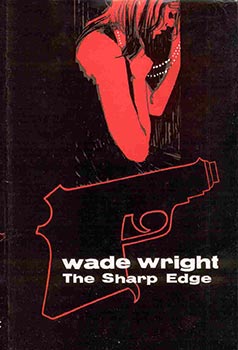
Suddenly You're Dead (1964),
Bart Condor
Blood in the Ashes (1964),
Bart Condor
A Hearse Waiting (1965),
Bart Condor
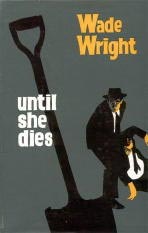
Until She Dies (1965), Bart
Condor
Blonde Target (1966), Bart
Condor
Shadows Don't Bleed, (1967)
Paul Cameron
The Sharp Edge (1968), Paul
Cameron
No Haloes in Hell (1969),
Paul Cameron
Two Faces of Death (1970),
Bart Condor
Don't Come Back! (1973),
Calhoun
The Hades Hello (1973), Paul
Cameron
It Leads to Murder (1981),
Matt Whitney
Death at Nostalgia Street
(1982), Lee Tyrell
The Girl from Yesterday
(1982), Calhoun
Echo of Fear (2007), Paul
Cameron
|
 |
| |
|
|
| |
|
|
The Ray Nolan Library
|
 |
The Dorne Gun (1986)
Friendly Invasion (1988)
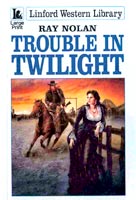
Trouble in Twilight
(1993)
Branded for Boothill
(1993)
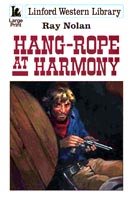
Hang-Rope at Harmony
(1994)
Guns of Golconda (1995)
Satan's Saddlemate
(1998)
Reckoning At Redemption
(2001)
Double-Cross Range
(2002) |
 |
| |
|
|
| |
|
|
Despite living in South Africa,
John chose to set all of his books in the United States of America. In
2007, he told
Mystery*File the reason: "Though I lived in a country that was
still a colony of the British Empire, and was born from Irish and
Welsh stock, I've always identified more with the US than Britain.
Possibly early reading habits and a love of movies helped a lot. I've
been to the States, but it was a long while ago. Always intended
returning, possibly for good, but moral obligations determined
otherwise."
Most of the Wade Wright novels went
out-of-print, but several have recently been reissued by Ramble House
via Lulu.com. Original imprints can often be found on eBay and are
regularly offered by sellers of first editions. Several of the Western
novels written as Ray Nolan remain available in large print editions
from Ulverscroft Large Print Books Ltd.
Other writing credits include short
fiction and articles for magazines and periodicals, including
Family Radio and TV, Detective Story Magazine, Under
Western Skies, Nostalgia and Screen Thrills. John
also wrote business manuals and advertising materials.
In 1962, John produced the first
comicbook fanzine to be issued outside the United States, which he
called The Komix. It ran for just two issues. A third was
planned, but was abandoned due to pressures of work at around the time
that Suddenly You're Dead was sold to Robert Hale. Remarkably,
John continued receiving enquiries from other countries about this
amateur publication, well into his retirement years. Indeed, copies of
the fanzine occasionally surface on online auction sites, with a copy
of the second issue once selling for $70 on ebay. Proof indeed that
there is always someone who remembers and appreciates what the
originator has long since forgotten!
In addition to his book writing
exploits, John could also boast an extensive list of credits in radio
drama, totalling over two hundred scripts for The Deciding Factor,
Suspense, Radio Theatre and Tuesday Theatre,
among others for Springbok Radio and
Radio South Africa. "Writing for radio was fun and lucrative...
Contracts were more than fair. Fees continually rose, and they covered
two broadcasts within a period of 14 days. If a show was aired again
after that period the writer was paid fifty per cent of his current
fee," John explained to
Mystery*File.This string to his bow certainly had its roots in
his love for radio drama as a youngster. When I spoke to him in 2002,
he fondly recalled his earliest memories of South African radio drama:
"As a kid, the old Pilot table-top with its 'magic eye' was just
another piece of furniture, but one that sometimes sprouted music, and
was positioned near my dad's chair, where he'd sit and listen to the
news. At that time commercial radio was not even a remote
consideration. Coming into the front room one evening, I overheard a
couple of mysterious voices emanating from the speaker... then a woman
screaming. It stopped me in my tracks. I seem to remember that it was
a drama, possibly something penned by Edgar Wallace. After that radio
took on a little more meaning."

The interest in radio grew to take
in audio recording and John made his first experimental recordings at
around the age of 15, when he acquired his first ¼" recorder. "It was
a second-hand Ampro, purchased from African Consolidated Theatres in
my second working year. The recorder operated with valves, had only
one input socket for a microphone, so recordings were not very good.
But it was fun, and interesting to experiment."
Economics dictated that many
recordings were not preserved. Initially, programmes would be kept
only if they had some special appeal. If there was little to warrant
keeping a programme, or, for instance, reception was poor, John would
tape over the recording. As recording tape spools became more
affordable, however, he began to record specific items, and his
collection of tapes quickly grew. Over the years, John amassed many
hundreds of tapes. " When we sold our home at Bluewater Bay, a number
of cartons got 'lost' in moving, among them recorded tapes of the
radio shows for which I'd written, manuscripts, and lots of personal
and valued correspondence," John revealed to Steve Lewis in 2007. Other
tapes
were given away or donated to official archives (including, of course,
The Avengers recordings, which he generously donated to the
Avengers on the Radio website, predecessor to The Avengers
Declassified).
Gradually, John began to cast his
eyes towards America and began purchasing US radio shows from
collectors there. "They were recordings of The Shadow, The
Green Hornet, and The Black Hood — characters I'd known
from comic books and pulp magazines, who I knew were featured on
radio, but whom I'd never heard. These I subsequently traded for
others, and it snowballed. Later I traded a number of South African
shows," John noted.
South African radio shows that were
particular favourites of John's included On Safari, Address
Unknown and SF-68. "And there were others," John commented
in 2002, "including the early shows featured on Springbok Radio that
were canned goods imported from Down Under. Nightbeat was a
favourite, and I enjoyed The Hidden Truth and Life With
Dexter, among others. Way back, possibly even before Springbok
Radio, there was an excellent series on Oscar Hammerstein... and
another on Dame Nellie Melba. I thought both to be great, and that was
even before I became hopelessly hooked on operetta and stage musicals.
I had no favorite actors, but if forced to name one it would have to
be Adrian Steed. Still active with TV commercials, this gentleman
remains one of the very best. Then there was Brian O'Shaughnessy, who
wrote Jet Jungle, and loads of other stuff, and who died only
recently. Brian was one of the last of the Old School."

As the task of finding blank
reel-to-reel tapes became increasingly difficult, John Wright
reluctantly ceased recording Springbok programmes — though his
increasingly hectic work schedule was another factor in his decision
to bring the practice to an end. He was initially intrigued by the
"new kid on the block" — compact cassette: "I found cassettes pretty
novel, and bought a recorder. Soon, though, I discovered their
limitations. And the problems so many presented. Jamming, snapping,
tangling — and one very well known brand reducing the recordings to a
bunch of screeches after only a year in storage. Lost a lot of good
stuff through them. But I remain a staunch supporter of the open-reel
machines. They may have taken up more space, but they had a lot more
to offer."
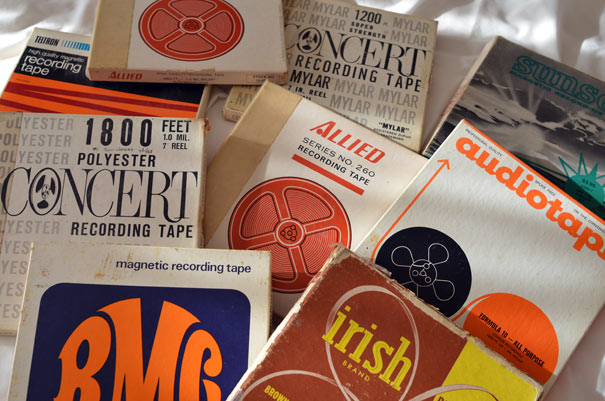
Image: John Wright's reel-to-reel tapes containing
recordings of The Avengers (© Alan Hayes)
Fans of both The Avengers
and South African radio have cause to be grateful for John's
dedication to South African radio. It is remarkable that well into the
2000s, he still retained most of the original tapes he recorded on the
open-reel format back in the 1970s. His recordings of The Avengers
and many other series have aged well — and have brought the golden age
of South African radio back into the limelight — and rightly so.

The vast majority of this feature
was written in 2002 for my old website Avengers on the Radio,
and was completed with John's enthusiastic assistance. I was in
contact with John for only a short period during his retirement years,
but I was regularly surprised at the time he would devote to answering my
questions — and of course his selfless generosity in donating the tape
reels to the website for restoration and our researches.
Our chats reached a natural
conclusion, and eventually the emails passing between the UK and Port
Elizabeth, South Africa, where he and Coral resided, slowed down to a
trickle. In the years that followed, I lost John's email and street
addresses in a hard drive failure, and often wondered what became of
him. I got my answer in June 2015 when I chanced upon an interview
with John by Steve Lewis on the
Mystery*File
blog. The discussion, conducted in 2007, contained a footnote in which
it was announced that John had passed away on 14th November 2008. He
was a gentle, open and warm person, and I am blessed to have known
him, even for a brief time.
Written by Alan Hayes
with grateful thanks to John Wright, Coral Wright,
Alys Hayes and
Steve Lewis of
Mystery*File
Back to Top |