|
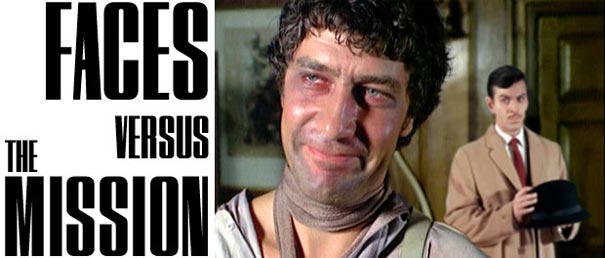
How did two episodes of
different British series made nearly a decade apart come to have so
much in common? J. Ferguson ponders this question for The Avengers
Declassified in a special feature.
As I slowly add to my
repertoire of British cult classic series, it becomes easier and
easier to discern certain themes and storylines that pop up over and
over in multiple incarnations. This is not in itself surprising. With
a common pool of writers, actors, directors, even sets, being shared
among multiple shows at the same time, there would obviously be a
modicum of repetition. Since The Avengers was the first series I viewed,
and is still the one with which I am the most familiar, it is not uncommon for me to spot episodes of other series with plots more than
a little reminiscent of particular exploits of Steed and Co. Pop
psychology, drugs, technology, doppelgangers, Cold War espionage,
betrayal — all are common themes resulting in similar episodes and
storylines. Indeed, it was not unusual for writers to recycle scripts
to meet a deadline. What they had written for, say, The Saint or
Danger
Man, could often be tweaked and altered to produce a story for The
Persuaders! or perhaps Randall and Hopkirk (Deceased). Indeed,
The
Avengers even recycled its own stories on more than one occasion, with
several Cathy Gale episodes remade later for the Emma Peel era.
Watching The Charmers back-to-back with The Correct Way to Kill
reveals whole swathes of word-for-word identical dialogue. Indeed,
with all of these facts in mind, there would seem to be no particular
reason why I should find the resemblance between episodes of The
Champions and The New Avengers to be particularly surprising or
unusual. And yet, upon viewing The Champions for the first time early
in 2009, I was indeed taken aback to find a strong degree of
resemblance between The Champions story, The Mission, and
Faces, a
perennial favourite New Avengers story.
 The scripts are by no means
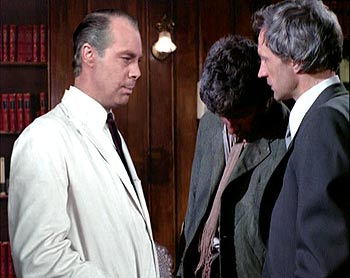
identical, but they have several elements in common. The Mission
follows a plastic surgeon, Dr Pederson, who, rather
uncharacteristically, runs a mission house for the homeless, even
going so far as to provide health care for the tenants. His motives
are not entirely altruistic, however. The mission is only the
surgeon's sideline. His main line is providing criminals with new
faces and identities so that they may flee with their ill-gotten
gains, untraceable by the law. The mission provides him with a
plethora of 'spare parts' needed to complete the operation. Similarly,
Faces gives us Dr Prator, another plastic surgeon, also running a
mission and using the tenants for raw material, although his
purposes are less gruesome — those with a passing resemblance to notable
civil servants are trained and altered to become perfect copies of
their better-off twins, and subsequently replace the genuine articles.
Once they are in place, they begin passing off secrets to Prator and
his co-conspirator, Mullins, who, in turn, sell them to the highest
bidder. Clearly, the plastic surgeon/mission storyline provides the
strongest link between the two stories, and the likelihood of both
ideas cropping up together on two different occasions without one
influencing the other seems highly unlikely. The scripts are by no means
identical, but they have several elements in common. The Mission
follows a plastic surgeon, Dr Pederson, who, rather
uncharacteristically, runs a mission house for the homeless, even
going so far as to provide health care for the tenants. His motives
are not entirely altruistic, however. The mission is only the
surgeon's sideline. His main line is providing criminals with new
faces and identities so that they may flee with their ill-gotten
gains, untraceable by the law. The mission provides him with a
plethora of 'spare parts' needed to complete the operation. Similarly,
Faces gives us Dr Prator, another plastic surgeon, also running a
mission and using the tenants for raw material, although his
purposes are less gruesome — those with a passing resemblance to notable
civil servants are trained and altered to become perfect copies of
their better-off twins, and subsequently replace the genuine articles.
Once they are in place, they begin passing off secrets to Prator and
his co-conspirator, Mullins, who, in turn, sell them to the highest
bidder. Clearly, the plastic surgeon/mission storyline provides the
strongest link between the two stories, and the likelihood of both
ideas cropping up together on two different occasions without one
influencing the other seems highly unlikely.
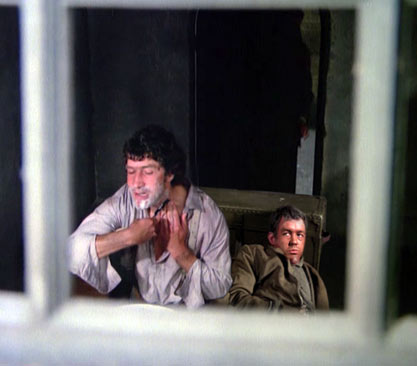
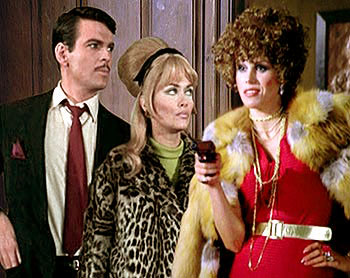 A
further,
notable parallel between the two stories concerns the personas adopted by
Nemesis agents Sharron Macready and Richard Barrett,
and those of Purdey and Gambit. Sharron poses as a gangster's moll,
Ann Collins, on the run with her boyfriend, played by fellow agent Craig
Stirling, looking to change her face to escape the clutches of the
law. Purdey, as Lolita, plays the part of the tarted up girlfriend of a bank robber looking to change
her face to escape the law. Both characters even adopt the same sort
of mannerisms: chewing gum, draping themselves over furniture,
dragging around fur coats over their shoulders, and posing. Richard,
meanwhile, pretends to be a homeless man in order to infiltrate the mission.
His connection to the charitable organisation is provided by a fellow down-and-out, a
drunken Irishman. Gambit, in comparison, also pretends to be homeless
in order to gain access to the mission. His persona, Terry Walton, another drunken Irishman, would seem
to be a neat melding together of the two
characters. It is this strong similarity between both the characters'
new identities and the basic set-up of the plot that hints at a script
for Faces that, while not a straight copy, seems to have borrowed
elements from The Mission. A
further,
notable parallel between the two stories concerns the personas adopted by
Nemesis agents Sharron Macready and Richard Barrett,
and those of Purdey and Gambit. Sharron poses as a gangster's moll,
Ann Collins, on the run with her boyfriend, played by fellow agent Craig
Stirling, looking to change her face to escape the clutches of the
law. Purdey, as Lolita, plays the part of the tarted up girlfriend of a bank robber looking to change
her face to escape the law. Both characters even adopt the same sort
of mannerisms: chewing gum, draping themselves over furniture,
dragging around fur coats over their shoulders, and posing. Richard,
meanwhile, pretends to be a homeless man in order to infiltrate the mission.
His connection to the charitable organisation is provided by a fellow down-and-out, a
drunken Irishman. Gambit, in comparison, also pretends to be homeless
in order to gain access to the mission. His persona, Terry Walton, another drunken Irishman, would seem
to be a neat melding together of the two
characters. It is this strong similarity between both the characters'
new identities and the basic set-up of the plot that hints at a script
for Faces that, while not a straight copy, seems to have borrowed
elements from The Mission.
Seeing the parallels, my first
instinct was to check the writing credits, to ensure that this was not
another case of a writer polishing up one of his old scripts. However,
The Mission
was penned by Donald James, who contributed several scripts not
only to The Champions, but also Randall and Hopkirk (Deceased),
The
Persuaders!, and Jason King, amongst others. His sole Avengers credit
is the John Bryce-produced Tara King story remade as Have Guns — Will Haggle
(originally written and filmed as Invitation to a Killing)
and
he bears no connection to The New Avengers at all. Faces was,
instead, a product of the infamous Brian Clemens/Dennis Spooner script
swap, in which the two writers, having hit a wall creatively, traded
stories — a process likely necessary due to the fact that they were
writing the majority of TNA's stories between them. Clemens had
himself written for The Champions, notably the well-regarded
Autokill, which bore a striking resemblance to the King era story
My
Wildest Dream. This makes it possible that he recalled the storyline
for The Mission almost a decade later from his association with the
series. On the flip side, Dennis Spooner was, of course, one of the
instigators behind The Champions. Indeed, he also played the role of
script supervisor on the series, which means it is entirely possible
that the basic premise behind The Mission was his own, with Donald
James enlisted to flesh it out into a fully-fledged script. Thus, it
could be the case that Spooner was the one to recall the storyline. Perhaps
he is a better candidate than Clemens?
This all seems fairly conclusive,
but problems start to arise when one
begins to check up on the logistics. Due to the order of the writing
credits, we are able to discern who began and finished each story.
Clemens receives first billing for Faces, while Spooner is the
instigator of Three Handed Game, the aforementioned other half
of the script swap. If each script was genuinely half-finished, with
the final act or so only left to be written, then that makes the
groundwork for Faces, all of which is set up in the first half,
Clemens' work. Indeed, the storyline begins to deviate more from that
of The Mission in the latter half, with Purdey dealing with the
aftermath of Gambit's 'death' at the hands of Terry Walton, while The
Mission involves Sharron's impending operation and Craig and
Richard's attempts to stop it. Did Spooner give Clemens the elements
of the story in the first place? If so, why did he not write the story
himself? Was he already too busy with
Three Handed Game, and so
gave Clemens the idea as a place to start? This is entirely possible,
particularly since both were obviously struggling to keep the creative
juices flowing over an extended period of time and several episodes.
It would seem the only explanation, but it still seems fantastic that
either Clemens or Spooner should recall even some aspects of a
storyline written and filmed nearly a decade earlier.
 Of course, Faces adds
another layer to the premise with the doppelganger element, the same
element only featuring at the end of The Mission, in which
Pederson fixes Boder's face to resemble his own. In addition, the
Champions work together throughout the story, while the Avengers split
up, with Purdey left on her own for the majority of the story. Was
this a conscious change by Clemens, introduced to alter the dynamic of
the storyline? After all, the way he splits Purdey off from Steed and
Gambit has always seemed somewhat arbitrary and manufactured. Steed
justifies keeping Purdey in the dark by telling Gambit they have no
way of knowing that Purdey has not been swapped for a double, but it
is never adequately explained why he is so confident that the same has
not happened to Gambit. Of course, having Purdey and Gambit working at
cross purposes is the source of much of the fun in this episode,
namely watching Terry and Lolita interact as they 'learn' to become
Purdey and Gambit. Scenes such as these would never have been possible
in The Champions, mostly because the team dynamic does not
allow it. The Purdey and Gambit relationship is replicated at a baser
level by Terry and Lolita, but has its roots in the back and forth
flirtation between the characters. Purdey and Gambit's relationship is
based on ever-present sexual tension and the promise of future
culmination. The Champions, meanwhile, has no such tension
within its trio, any interest in Sharron coming from the outside,
while Richard and Craig treat her as a close friend and colleague, but
never make romantic overtures. To lift the script for The Mission
exactly would have resulted in unrealistic interactions between the
characters, and clearly either Clemens or Spooner saw the potential in
writing fresh material that could play with Purdey and Gambit's
infamous 'intercourse'. Later on, we see Purdey's reaction to Gambit's
demise, providing us with a nice sketch of the relationship between
the two characters, again one that would not have played out the same
way in The Champions. Of course, Faces adds
another layer to the premise with the doppelganger element, the same
element only featuring at the end of The Mission, in which
Pederson fixes Boder's face to resemble his own. In addition, the
Champions work together throughout the story, while the Avengers split
up, with Purdey left on her own for the majority of the story. Was
this a conscious change by Clemens, introduced to alter the dynamic of
the storyline? After all, the way he splits Purdey off from Steed and
Gambit has always seemed somewhat arbitrary and manufactured. Steed
justifies keeping Purdey in the dark by telling Gambit they have no
way of knowing that Purdey has not been swapped for a double, but it
is never adequately explained why he is so confident that the same has
not happened to Gambit. Of course, having Purdey and Gambit working at
cross purposes is the source of much of the fun in this episode,
namely watching Terry and Lolita interact as they 'learn' to become
Purdey and Gambit. Scenes such as these would never have been possible
in The Champions, mostly because the team dynamic does not
allow it. The Purdey and Gambit relationship is replicated at a baser
level by Terry and Lolita, but has its roots in the back and forth
flirtation between the characters. Purdey and Gambit's relationship is
based on ever-present sexual tension and the promise of future
culmination. The Champions, meanwhile, has no such tension
within its trio, any interest in Sharron coming from the outside,
while Richard and Craig treat her as a close friend and colleague, but
never make romantic overtures. To lift the script for The Mission
exactly would have resulted in unrealistic interactions between the
characters, and clearly either Clemens or Spooner saw the potential in
writing fresh material that could play with Purdey and Gambit's
infamous 'intercourse'. Later on, we see Purdey's reaction to Gambit's
demise, providing us with a nice sketch of the relationship between
the two characters, again one that would not have played out the same
way in The Champions.
It is true that many storylines
were recycled among the various series in the Sixties, but for such
similar elements to survive the almost decade-long gap between The
Champions and The New Avengers still seems surprising, at least to me.
No other explanation seems to fit, except that of long memories at
work!
Written by J Z Ferguson — Anew
Photo montages by Alan Hayes
Back to Top |