|
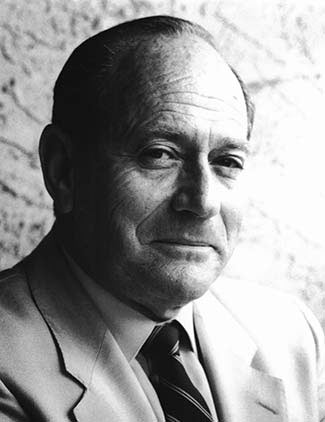
Donald
Monat was a gifted actor, writer, producer and director who met with success
the world over. He was a
top-line star of South African radio, produced and performed comedy
revues on the London stage, made his own feature and short films, worked as a voice-artiste in the
USA and in later life published a Sherlock Holmes novel, The
Merchant of Death, co-written with his wife, June Dixon.
Between 1971 and 1973, Donald played John Steed in the South African radio
adaptation of The Avengers produced for Springbok Radio by Dave
Gooden at Sonovision Studios in Johannesburg.
Donald was interviewed in 2000
by Alan Hayes and in April 2001 by Avengers fans at The
Avengers Forum. What follows is a compilation of those two
conversations.

To begin with, Donald recalled
how he became involved in South African Radio.
"I was born in London, but grew up
in South Africa, went to school and university there, and started
acting for radio when I was 16. I went back to England in 1949, where
I first met my wife, June Dixon, when we were working together in a
stage play in London. When the SABC commercial service, Springbok
Radio, began in 1950, we went back to Johannesburg and started one of
the first radio production companies, personally producing about 15
shows a week. After 2 years of hectic work, we went back to London and
worked extensively in theatre doing plays and revues. We also worked
in radio and television and made a couple of short movies. One of
them, Five Guineas A Week, was nominated for the Royal Command
Film Performance and opened at the Odeon Leicester Square with The
Spanish Gardener. We also created one of the first original
musical comedies for British TV. It was called The Straker Special
and starred June Whitfield and Dennis Quilley. All this was way back
in the fabulous Fifties. In 1960, we went to Canada, where we worked
mainly in radio for CBC, and occasionally in theatre and documentary
films. After two years, we went back to South Africa in 1962 for
family reasons after the sad death of my brother there. Originally it
was only going to be a visit for a few months, but we were asked to do
a stage revue, then a radio comedy show ... and then one thing led to
another and fairly soon we were working morning, noon and night on our
own weekly programmes — The ABC Show,
Dr Livingstone — I Presume?, The Loudspeaker Show,
Stop the Tape — I Want to Get Off!, Son of Livingstone and
Cool — doing our best to support ourselves and our five young children. Most of them were done in front of live audiences
— with
live orchestras or groups — very much in the style of the classic BBC
comedy shows. Of course, we both also worked as actors (and directors)
for dozens of other shows. During this period (1962-82), I'm guessing
that I must have played in well over 2,000 radio programmes — needless
to say, I never counted them!"
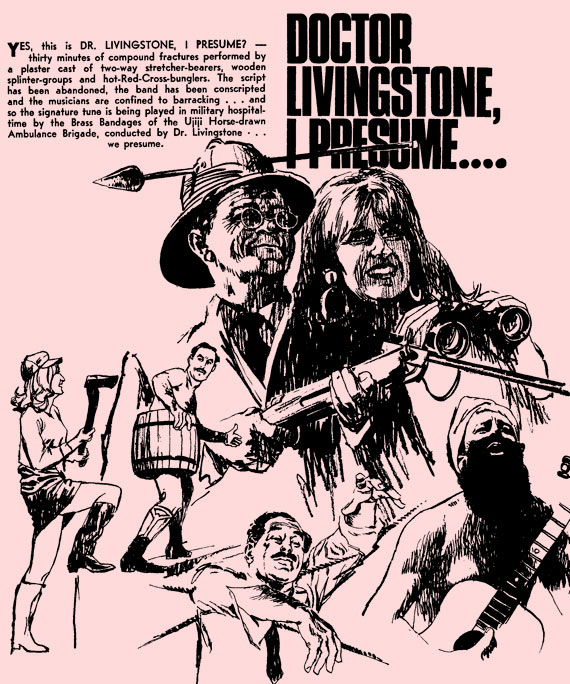
Image: SAUK-SABC Bulletin, kindly donated by Donald
Monat

So, how did you come to be cast
as John Steed in the radio adaptation of The Avengers?
"This could be a very complex
story. I do remember that the idea for the series didn't originate
with Sonovision. In fact, several months before the first Sonovision
recording I did an Avengers pilot with another production
company called AFS (after its owner, A.F. Stanley). Someone else
played Steed, and there was a different director. I believe it may
have been Colin Fish, who later played "Mother" in the Dennis Folbigge
adaptations at Sonovision. I think I played the chief villain... in
fact I have a vague memory that we did it twice with two different
Steeds. Anyway — for one reason or another the client was presumably
not happy, and the next thing I heard was that the project had shifted
to Sonovision and that they wanted me to play Steed."
With no television service in
South Africa at the time, had you managed to see any episodes of
The Avengers prior to playing the part of John Steed?
"Yes, we did have the pleasure of
seeing many of the TV episodes, long before the idea of doing the
radio series came up, and we thoroughly enjoyed them. They weren't
shown in cinemas in South Africa, but you could rent 16mm prints of
the films — in fact, we saw many British and American TV series that
way. We, like many of our friends, owned a 16mm projector and, at the
time, there were film rental libraries in every suburb — much like the
video stores of today. I'm sure that Dave Gooden and The Avengers
directors, Dennis Folbigge and Tony Jay must have seen them too."
Did you look to the television
series for inspiration on how to play the role of John Steed?
"I'm sure Patrick Macnee's great
performance had become embedded in my memories, but I didn't actually
study the TV episodes at the time. I guess I was aiming to interpret
the script in the spirit of the TV series, but in my own way — as my
voice is quite different to Patrick's."
With tongue-in-cheek humour very
much an element of The Avengers radio series, did you find your
extensive experience in radio comedy a particular help when
approaching the role of John Steed?
"Yes, I'm sure that spending many
years in comedy was a big help in keeping a light touch in The
Avengers. After all these years, it's hard to remember the details
of other shows I was doing at the same time but, looking up an old
magazine article from 1973, it seems I was directing a drama series
about two truck drivers called Wheels, playing regularly in
Medical File, Personal Column, Max Headley — Special
Agent and The White Oaks of Jalna, hosting a musical panel
game called Going For A Song and June and I were writing and
starring in a weekly satirical comedy show called Stop the Tape — I
Want to Get Off!."

How would a daily radio series
like The Avengers have been made?
"To appreciate how they were
produced, you probably need to understand a little about the crazy,
hectic world of South African radio. In its golden period, from the
mid-Fifties to the mid-Seventies, South African radio networks were
producing an astonishing volume of programming. They broadcast full
services in English, Afrikaans and several African languages including
Xhosa, Zulu, Tswana and Sotho. In English alone, they were turning out
some forty-five hours a week of original drama and comedy programmes —
which was probably considerably more than the total output of BBC
Radio Drama at the time. The extraordinary thing was that this was
done with a very small pool of actors. Ninety percent of the work was
done by a group of less than forty of us who went from studio to
studio all day long, recording everything from Shakespeare to soap
opera and, on a good day, a few commercials, which were much better
paid. Many of the actors might also be working in the evening in a
stage production. As a matter of interest, at the time I did The
Avengers, I was also writing, directing and playing in several
other programmes.
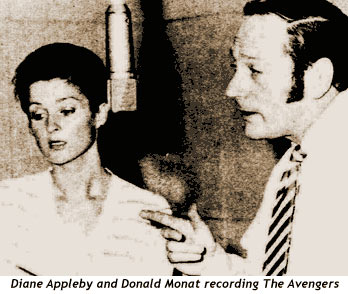 Budgets were tiny
— and so were the fees, which meant that you had to
do a great volume of work to make a living. The principal and most
successful radio actors became very skilled — and so did the
technicians, which was essential as rehearsal time was minimal. A
major, 90-minute play-of-the-week had to be rehearsed and recorded in
one day — and serials like The Avengers were recorded at sight,
with no rehearsal or read-through, five or six episodes in one
afternoon. Normally, you didn't even get the scripts in advance. The
first time you saw them was when you walked into the studio for the
recording. All live effects (such as footsteps, doors opening, drinks
being poured etc) were done by the actors and all recorded effects and
music were normally incorporated as we recorded so that there was very
little editing or post-production to be done." Budgets were tiny
— and so were the fees, which meant that you had to
do a great volume of work to make a living. The principal and most
successful radio actors became very skilled — and so did the
technicians, which was essential as rehearsal time was minimal. A
major, 90-minute play-of-the-week had to be rehearsed and recorded in
one day — and serials like The Avengers were recorded at sight,
with no rehearsal or read-through, five or six episodes in one
afternoon. Normally, you didn't even get the scripts in advance. The
first time you saw them was when you walked into the studio for the
recording. All live effects (such as footsteps, doors opening, drinks
being poured etc) were done by the actors and all recorded effects and
music were normally incorporated as we recorded so that there was very
little editing or post-production to be done."
I assume that some post
production would have been a regular part of the process, if a
programme was not coming in at the correct duration, for instance?
"In general, radio post-production
was primarily, cutting to time — but also tightening up and removing
any goofs. Most of the actors' mistakes (which we used to call
"fluffs") were removed during recording by simply going back and
"picking up" (what we now call "punching in") at a suitable point just
before the fluff. However, there were always some minor goofs which
would be taken out afterwards. Cuts, in those days, were nearly always
made by physically cutting and splicing the tape. When there were too
many splices in a tape for broadcast safety (more than say four or
five), it would dubbed in its entirety on to a fresh tape."
One of the many notable elements
of The Avengers radio series is its clever and lively use of
music in the productions. Would these tracks have been played in from
disc?
"Yes, incidental music would almost
certainly have come from library material. Each producer had his or
her own favourite libraries of theme and background music and it would
normally be played in from disc. Any regularly used themes would
usually be transferred to tape to avoid disc wear."
How were the production chores
distributed amongst the studio staff?
"Generally, the director was responsible for the artistic side of the
production — in particular the actors, the effects and the music. The
producer was normally responsible for the overall administration and
organisation of the production — but this varied from person to
person. Avengers producer and Sonovision Studios owner, Dave
Gooden (having a technical background) tended to supervise the sound
engineering side of the production in addition to his organisational
role. The controller (who was really what we call a sound mixer or
engineer today) sat at the console and controlled levels of the
various channels in the mix. As far as I can remember, Paul Wright was
fairly regularly the controller on The Avengers, but not
always. In some production houses, the Producer and the Director were
often the same person. I, myself, frequently did both jobs."

As a series that was sponsored
by a commercial concern — Lever Brothers — would The Avengers
have been subject to any rules or demands from that sponsor?
 "When Springbok Radio started in
1950, many programmes were fully sponsored. The sponsors bought the
time and directly commissioned and paid for the programmes. This gave
them the right to approve all scripts and recordings and insert their
own commercials, subject to the rules and practices of the network.
This was in the style of American commercial radio. However, by the
time The Avengers took to the air in the Seventies, things had
changed. Most programmes were selected, approved and paid for by the
network and advertisers simply bought commercial spots within them.
But there was also a form of limited sponsorship which gave the
advertiser the right to a "presented by" type of credit such as the
"Now, from the makers of Cold Water Omo..." "When Springbok Radio started in
1950, many programmes were fully sponsored. The sponsors bought the
time and directly commissioned and paid for the programmes. This gave
them the right to approve all scripts and recordings and insert their
own commercials, subject to the rules and practices of the network.
This was in the style of American commercial radio. However, by the
time The Avengers took to the air in the Seventies, things had
changed. Most programmes were selected, approved and paid for by the
network and advertisers simply bought commercial spots within them.
But there was also a form of limited sponsorship which gave the
advertiser the right to a "presented by" type of credit such as the
"Now, from the makers of Cold Water Omo..."
To the best of my recollection,
Lever Brothers had held the daily 7.15pm strip since the days of full
sponsorship and then simply carried on with the more limited form
permitted. But, as far as I can remember, although they could and did
make suggestions (particularly when new series were being developed),
this did not give them the right to approve or reject actual scripts
or individual programmes in the Seventies. That was the sole
prerogative of the network. All any unhappy advertisers could do was
to withdraw their advertising — rather like the situation in network
television today in the US and, presumably, the UK."
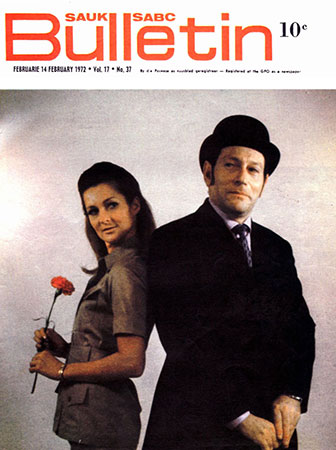 The Avengers was quite a
success on Springbok Radio. Did you have any publicity duties? The Avengers was quite a
success on Springbok Radio. Did you have any publicity duties?
"Diane Appleby, the actress who
played Emma Peel, and I were asked to do promotional public
appearances on quite a few occasions. The famous photo of Diane and
myself was one of a bunch of publicity shots that were taken at the
time. That particular one was printed up as a postcard and distributed
widely when we made any promotional public appearances... we used to
sign hundreds of them. I think Springbok may have also distributed the
pictures to fans. The show was certainly very successful and attracted
a large prime-time audience."
Looking back, how do you view
your time making the radio series of The Avengers?
"I thoroughly enjoyed playing in
The Avengers because the stories were great fun, Steed was a
wonderful role and, for me, a special bonus was that I didn't also
have to worry about all the responsibilities of production which I had
to handle in a great deal of my radio work."

How were people in the arts in
South Africa, like yourself, affected by the political unrest in the
country?
"Many of us were deeply affected by
it. When we went back in 1962, we ran into major problems with our
stage revue in Cape Town, Party Lines, which had a multi-racial
cast and we were always having hassles with the censors over our radio
comedy shows which frequently ridiculed the appalling policies of the
nationalist government. However, in all fairness to the SABC, they
did let us have a surprising amount freedom to do this and, in fact, I
think it's fair to say that many artists and writers made major
contributions in pressing for the reforms that ultimately brought
about the collapse of apartheid and the emergence of the new South
Africa. It's a complex and serious story, but I hope that gives you a
little perspective."
How would a programme like
The Avengers have been affected by censorship?
"At that time in South Africa the
various media — print, films and radio — came under censorship from
different boards or bodies. For radio, there were even different
procedures for the different networks but, in the case of Springbok
Radio programmes (as distinct from the commercials), each programme
episode tape had to be submitted to the station a week in advance for
servicing, together with two copies of its script and the appropriate
music clearance returns. If some words or lines were not acceptable
they were usually edited out by the Service Department. If major
surgery was required they would contact the production company who
might then have to re-edit or even re-record. However, most producers
were well aware of the acceptance code and tended to steer clear of
anything that might be rejected. Things that were unacceptable were
rather like the BBC in the old days — bad language, explicit sex,
anything that might be construed as sacriligous, or an attack on the
government. I don't think The Avengers ran into many major
problems as the original TV scripts already reflected the acceptance
policies of British and American commercial television in the 1960s —
which were not all that different.
Springbok Radio programmes were
censored (or what the station considered "approved for broadcast")
only as finished recordings. The people who did this were not really a
government department — they were employees of the SABC, which (at the
time) was rather like the BBC — i.e. an independent body, but
ultimately responsible to a minister of the government.
Our own comedy shows were in a
different situation. They ran into problems on Springbok Radio all the
time, although we did manage to slip some pretty nifty stuff through,
mainly because some of the overworked servicing people were not always
paying full attention and sometimes missed the more subtle jokes.
However, on the non-commercial English Service (where many of our best
series were broadcast) there was no specific censorship. Each producer
was held responsible for the programmes he or she put out. Nearly all
of them were on the staff, of course, and so were not inclined to risk
their jobs — but I was in the fortunate position of being one of the
very few freelance producer/directors who also worked directly for the
English Service.
Our shows were designed to be
topical, and they were usually written and recorded only a few days
before transmission. I did all the editing personally, often
delivering a programme tape to the continuity suite only an hour or
two before broadcast. Generally, the first time anyone in senior
authority ever heard them was when they were broadcast. As a result of
this, we got ourselves into deep trouble on several occasions!"

When the 'golden age' of radio
drama and comedy drew to a close in South Africa, how were June and
yourself affected professionally?
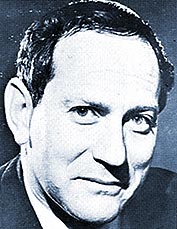 "In the Seventies and early
Eighties, we moved into films and television in South Africa. Our
first feature, Fraud! was a low-budget thriller which June and
I wrote. I directed the movie and June played one of the leads. We
also did a prime-time comedy TV series called The Saturday Show
and wrote and produced an original TV musical based on O. Henry's
famous short story, The Gift Of The Magi. Finally, in 1984, we
moved to Los Angeles — where we have lived ever since, working mainly
as writers and producers of corporate multi-media presentations...
although I still do quite a lot of voice work for narration,
commercials and books-on-tape. Throughout the last thirty years we
have made frequent, short trips back to the UK where we still have
friends and family, so we keep reasonably up to date on the
entertainment scene in Britain." "In the Seventies and early
Eighties, we moved into films and television in South Africa. Our
first feature, Fraud! was a low-budget thriller which June and
I wrote. I directed the movie and June played one of the leads. We
also did a prime-time comedy TV series called The Saturday Show
and wrote and produced an original TV musical based on O. Henry's
famous short story, The Gift Of The Magi. Finally, in 1984, we
moved to Los Angeles — where we have lived ever since, working mainly
as writers and producers of corporate multi-media presentations...
although I still do quite a lot of voice work for narration,
commercials and books-on-tape. Throughout the last thirty years we
have made frequent, short trips back to the UK where we still have
friends and family, so we keep reasonably up to date on the
entertainment scene in Britain."
Many thanks to Donald Monat for
kindly taking the time to answer the questions in such an open,
interesting and detailed fashion.
by Donald Monat and Alan Hayes
with additional questions from
Jane Clarke, Alys Hayes,
Martin Holder and Andrew Shepherd
The original Avengers Forum
interview is preserved here
Back to Top |